Ketamine-Assisted Therapy: What High-Achievers Get Wrong About KAP
By Giulia P. Davis, LMFT | Mycelia Therapy | San Francisco, California

You are running a company, managing a team, holding it together in every meeting, every conversation, every quarterly review. And somewhere in the background, there is a version of you that went quiet a long time ago. Not broken. Not falling apart. Just ... not reachable anymore.
After fifteen years in management consulting for Fortune 500 clients, I sat across from people like this every week. Now, as a therapist, I still do. The difference is that I have a tool most talk therapists don't offer. Ketamine-assisted psychotherapy, or KAP, is a legal, clinically supervised process that works with the nervous system in a way traditional therapy alone often cannot.
“Most high-functioning people don’t need someone to tell them what’s wrong. They need a way back into a part of themselves that performance taught them to override.”
This post is for the person who has done therapy, gotten something out of it, and hit a ceiling. The one who keeps showing up and performing but privately wonders why they still feel like they're watching their own life from behind glass.
Key Takeaways
- KAP is therapy-driven, not medicine-driven. Preparation and integration are where lasting change happens.
- It's not only for people in crisis. It's also for high-functioning people who feel stuck, numb, or disconnected.
- Couples can do KAP together. It's one of the more powerful ways to break through entrenched relational patterns.
- The experience is more grounded and intentional than most people expect.
What Is Ketamine-Assisted Therapy?
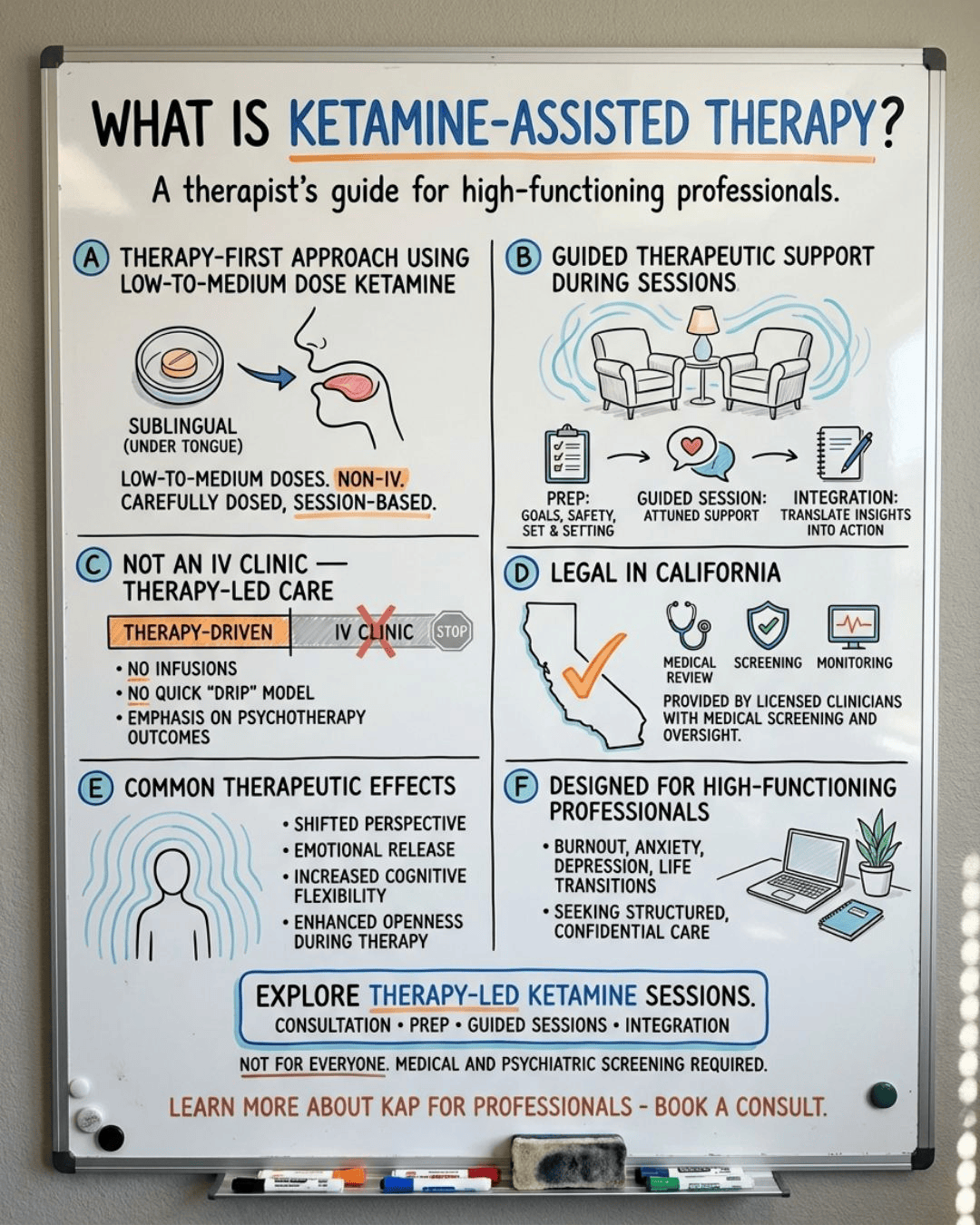
Ketamine-assisted psychotherapy (KAP) is a clinical treatment that combines low-to-medium-dose ketamine with guided therapeutic support. Esketamine, a derivative, received FDA approval for treatment-resistant depression in 2019, and off-label ketamine use has been expanding across therapeutic settings since. In my practice, I use sublingual lozenges administered during a live virtual session, not the IV infusion model you may have seen marketed by ketamine clinics.
The distinction matters. IV clinics often provide ketamine as a standalone medical procedure. In ketamine-assisted psychotherapy, the medicine is one element within a larger therapeutic process. There's a preparation phase before the session. There's a trained therapist present during the experience. And there's integration work afterward, where the real shifts take root.
Ketamine is legal in California. It is not experimental. And it is not the same thing as the recreational drug you may have heard about. The dose, setting, intention, and clinical oversight create a fundamentally different experience.
Why Do Founders and High-Achievers Seek KAP?
Research has found that couples wait an average of nearly three years from the onset of serious problems before entering therapy (Doherty et al., 2021). For high-functioning individuals, founders especially, it often takes longer, because they have more tools for appearing fine.
Here is the pattern I see again and again. Someone who is successful by every external measure. They are running a company, closing a fund, managing a team, holding a household together, showing up for their kids.
And inside, something has gone flat.
They describe it as stuck. Numb. Overcontrolled. Cut off from something they used to feel but can't quite name.
Many founders and high-achievers are extremely functional on the outside while becoming internally rigid, emotionally cut off, perfectionistic, or fused with output and control. The role itself reinforces this. You are rewarded for managing, anticipating, performing, staying several moves ahead.
“Over time, those capacities stop being skills you deploy and start being the only way you know how to exist.”
Traditional therapy helped. To a point. They have language now for their patterns. They understand their attachment style, their family of origin dynamics, maybe even some of the ways burnout has reshaped how they function. But understanding hasn't translated into feeling different. The insights are there. The embodied shift is not.
“They don’t need more insight. They need access to the parts of themselves that insight alone can’t reach.”
The strongest case for a founder considering KAP sounds something like this: "I have built a life that works on paper, but I still feel stuck, numb, depressed, overdriven, or unable to imagine another way." In those cases, KAP may help not by optimizing hustle, but by interrupting the mental and emotional groove that the person can no longer think their way out of.
“The question is not whether ketamine will make you a better entrepreneur. The better question is whether you have become so adapted to performance that you no longer know how to access anything beyond it.”
KAP can help because it doesn't just work with the thinking mind. Ketamine temporarily quiets the default mode network, the part of the brain responsible for the running self-narrative, the constant planning, analyzing, and self-monitoring (Lehmann et al., 2020). For someone whose default mode has been stuck on high for years, that neurological pause can open space for something different.

What Are the Biggest Misconceptions About KAP?
The biggest misconception is that ketamine does the work for you. It does not. Ketamine may open a door, but the therapy, the preparation, and the integration are what help change last.
Here are the four things I correct most often:
"It's a magic fix." It is not. KAP is not a single session that rewires your brain overnight. It is a therapeutic process. The medicine creates conditions for deeper work, but without skilled facilitation and committed integration, those conditions close.
"It's mostly about having a wild or mystical experience."
Sometimes the experience is vivid. Sometimes it is quiet. The deeper value is not the spectacle. It is that ketamine softens rigid patterns and creates room for a different relationship to your thoughts, your emotions, and yourself."It's only for people in extreme crisis." This one keeps a lot of people away who could genuinely benefit. KAP is not only for treatment-resistant depression or acute suicidality. It can also help high-functioning people who look fine on the outside but feel stuck, numb, overcontrolled, or cut off inside.
"The therapist is just a babysitter during the session." Some clients want to turn inward and be mostly with themselves during the medicine experience. That's welcome. But there is a difference between holding space quietly and being absent. I am present throughout, attuning to what is emerging, holding the container, and available when the client needs support. Sometimes that means being a calm, safe presence in the background. Sometimes it means gently guiding. Either way, this is not a medical procedure where someone administers a drug and leaves the room.
“The medicine doesn’t do the work. It makes the work possible.”
A Note for Founders: This Is Not a Biohack
I want to name something directly, because I see it in the entrepreneurial world and it concerns me. There is a growing temptation to treat ketamine like a strategic edge. A performance tool. A biohack for the already-optimized.
That is exactly the wrong frame.
Ketamine is a controlled substance with real risks, including dissociation, transient blood pressure increases, psychomotor impairment during the session, and misuse potential. It is contraindicated in certain cardiovascular conditions and in patients with schizophrenia. It should only be used in a legitimate medical and therapeutic setting, with a prescribing physician and a trained therapist involved.
“Entrepreneurs should consider ketamine-assisted therapy not to become more productive, but when productivity has become the armor around pain, numbness, or a life that no longer feels inhabitable.”
The potential value of KAP for founders, executives, and entrepreneurs is not that it turns someone into a better machine. In the right case, it may help loosen entrenched patterns, soften self-protective overcontrol, and create enough psychological flexibility for grief, fear, desire, or alternative ways of living to come back into view. The medicine can open a window. The preparation, therapy, and integration are what determine whether anything meaningful changes.
“You did not build your company by being soft with yourself. But the same relentless drive that built the company may be the thing standing between you and actually being alive inside it.”
If you are considering KAP because you want an edge, pause. If you are considering it because something in you has gone quiet and you have run out of ways to reach it on your own, that is a different conversation. And it is one worth having.
What Does a KAP Session Actually Feel Like?
What surprises most people is how grounded and intentional the experience feels. A lot of first-timers come in expecting something dramatic or disorienting. What they find instead is a space that is carefully held, spacious, and deeply human.
A KAP session with me begins with slowing down. We are not rushing toward the medicine. We are getting oriented. Listening for what feels important, what feels stuck, what feels tender, what may be asking to emerge. By the time the medicine enters the process, the client is not being dropped into an abstract altered state. They are entering an experience with intention, context, and support.
During the session itself, people often describe a softening of the usual mental grip.
“The inner narrator becomes less dominant. Defenses that are normally fast, polished, and highly practiced may loosen.”
For high-achieving clients especially, this can be profoundly relieving. People who are used to managing, performing, anticipating, or staying tightly organized internally may have their first real experience in a long time of not having to hold themselves together in quite the same way.
The experience doesn't always feel blissful. Sometimes it's spacious. Sometimes emotional. Sometimes strange, symbolic, or unexpectedly quiet. Sometimes clients feel a sense of distance from their usual story and are able to look at it with more compassion and less fusion. Sometimes grief comes into view. Sometimes possibility does. Sometimes what emerges is not a revelation but a subtle shift: a little more room around a familiar pain, a little less certainty about an old identity, a little more access to feeling, imagination, or truth.
“You don’t need to have a “good” ketamine experience. You get to be in the experience rather than managing how it appears.”
Because sessions are virtual, clients are in their own space. Their couch. Their blanket. Their room. That matters. The environment already belongs to them. My job is to make sure the therapeutic container within that space feels calm, non-performative, and deeply held. Nothing extra is being demanded. Clients do not need to impress me, produce insight on command, or perform their way through it.
How Does KAP Work for Couples?

Early research on ketamine-assisted couple therapy shows improvements in communication, trust, and relationship satisfaction lasting six weeks to fifteen months post-treatment (Frontiers in Psychiatry, 2024). For couples who have been locked in the same patterns for years, that kind of opening can change the trajectory of a relationship.
KAP with couples is not two parallel individual experiences happening side by side. It is a therapeutic process that works with the relational field between two people. The medicine can soften entrenched dynamics, lower defensiveness, and make it easier for each partner to access vulnerability, empathy, and new ways of seeing both themselves and each other.
For some couples, that means moving beyond the same repetitive argument into the deeper pain underneath. For others, it means rediscovering tenderness, grief, fear, longing, or care that has been obscured by years of protection and conflict.
“Each person may become more reachable to themselves and to the other.”
What often feels different for couples is that the medicine creates enough space for each person to step outside the rigid role they usually occupy in the relationship. The pursuer is not only pursuing. The withdrawer is not only withdrawing. Each person has a moment of contact with themselves that isn't filtered through the relationship's defensive structure.
That can be moving. It can also be delicate. Which is why the therapeutic container, the preparation, the clinical attunement during the session, and the integration afterward, matters even more in couples work than individual.
If you've been considering intensive couples therapy but feel like you keep hitting the same wall, KAP may be the thing that lets you get underneath it.
What Does the Full Process Look Like?
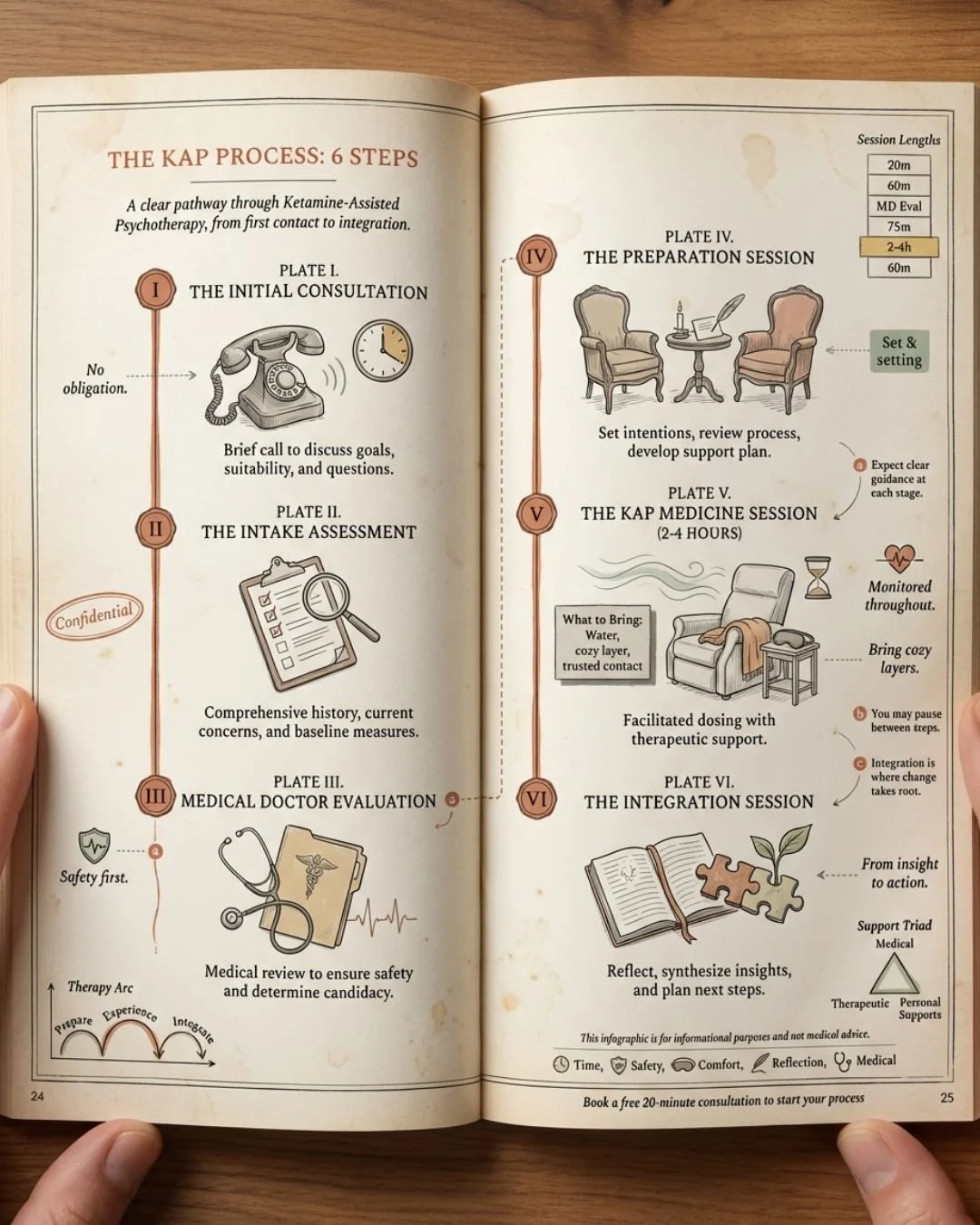
The KAP process has six stages, and the medicine session is only one of them. Here's what the full pathway includes:
1. Free 20-minute consultation. We talk about what you're dealing with, what you've already tried, and whether KAP might be a fit. This is a conversation, not an intake form.
2. 60-minute intake assessment. A deeper clinical evaluation of your history, current functioning, goals, and readiness.
3. Medical doctor evaluation. A physician reviews your medical history and, if appropriate, prescribes the ketamine. This is a legal and clinical safeguard.
4. 75-minute preparation session. We set intentions, discuss what to expect, and build the therapeutic frame that will hold the experience. This is where trust gets built.
5. KAP session (2-4 hours). The medicine session itself, with me present throughout. Sublingual lozenges, not IV. You are in your own space (sessions are virtual for California residents), and I am with you the entire time.
6. 60-minute integration session. We process what emerged. We look at what shifted, what surprised you, what wants attention. Integration is where the medicine experience becomes lasting therapeutic change.
Some people do a single KAP session. Others engage in a series of sessions over weeks or months. The process is individualized, not one-size-fits-all.
Is KAP Right for You?
KAP may be a good fit if you are dealing with something clinically meaningful or persistently life-limiting: depression, persistent stuckness, burnout with depressive features, trauma-related rigidity, or a pattern of overcontrol that has not shifted through ordinary means. If your body holds a tension that your mind has already analyzed a hundred times. If you are curious about a different kind of therapeutic experience but want it held in a rigorous clinical frame, not a retreat setting or a party.
It may not be the right fit right now if you have a history of psychosis, are on certain medications (particularly MAOIs), or are looking for a shortcut around doing the relational work. KAP is not a bypass. It is a deepening.
“KAP isn’t about escape. It’s about contact. Contact with parts of the self that have gone offline. Contact with emotion that has been over-managed. Contact with grief, desire, truth, or possibility.”
And in couples work, contact with each other in ways that the ordinary defensive structure of the relationship may no longer allow.
Frequently Asked Questions
Is ketamine-assisted therapy legal?
Yes. Ketamine is a legal, FDA-recognized medicine. Esketamine (Spravato) was approved by the FDA for treatment-resistant depression in 2019. Off-label ketamine use in therapeutic settings is legal in California and supervised by a licensed prescribing physician.
Can couples do KAP sessions together?
Yes. I work with couples doing KAP together. The process includes joint preparation, a shared medicine session with me present, and joint integration. It is one of the more powerful modalities I offer for couples who have hit a relational ceiling. Early research supports improvements in communication and relationship satisfaction.
How many KAP sessions does it typically take?
It depends on the person and the goals. Some clients do a single session and find it opens something meaningful. Others engage in a series of 2-8 sessions spaced over weeks or months, each followed by at least one integration session.
What's the difference between KAP and ketamine infusions?
Ketamine infusion clinics typically administer ketamine intravenously as a standalone medical procedure, often without a therapist present during the experience. In KAP, the medicine is one element within a full therapeutic process, including preparation, real-time clinical support during the session, and structured integration afterward.
Does insurance cover ketamine-assisted therapy?
Most insurance plans do not cover KAP directly. However, the therapy sessions (preparation and integration) may be reimbursable depending on your plan. I can provide superbills for out-of-network reimbursement.
What if nothing dramatic happens during my session?
That's common and completely fine. Not every session is vivid or emotionally intense. Some of the most meaningful sessions are quiet ones. The therapeutic value is in how we prepare, how I attune during the process, and how we integrate afterward. A session doesn't need to be dramatic to be useful.
If any of this sounds like where you are, I offer a free 20-minute consultation to talk about whether KAP might be the right next step. I work with individuals and couples throughout California via secure telehealth.
About the Author

Giulia P. Davis, LMFT & Founder Mycelia Therapy
(she/any pronouns)
Giulia P. Davis, LMFT, is the founder of Mycelia Therapy in San Francisco. She spent fifteen years in management consulting for Fortune 500 clients before becoming a therapist.
She is a certified ketamine-assisted psychotherapy provider trained at Alchemy Community Therapy Center and specializes in intensive work with high-achieving professionals and couples.
Giulia offers weekly therapy, intensives, and psychedelic-assisted therapy throughout California. She also works as a co-founder therapist, helping co-founders and employees resolve disputes inside companies.
→ Learn more about Giulia ·LinkedIn ·Psychology Today ·Verify License