AI Overwhelm Is Real — And It Has Little to Do With the Tools
By Giulia P. Davis, LMFT | Mycelia Therapy | San Francisco, California

AI isn't creating the anxiety you're feeling. It's revealing something that was already there.
Does that resonate? If so, then —
You don't have an AI problem. You have an identity problem.
The real question then isn't which tool to learn next. It's what AI is exposing about how you've learned to measure your worth.
After 15 years advising Fortune 500 companies — and now working as a therapist with the executives and entrepreneurs living through this moment — I can tell you: the overwhelm you're feeling isn't really about AI itself.
“💬 What most people call AI overwhelm isn’t a tech problem. It’s an identity crisis wearing a tech costume.”
And the people most at risk aren't the ones who feel behind. They're the ones who built their entire sense of worth around being ahead.
What Is AI Fatigue — And How Do You Recognize It?
AI fatigue is what happens when the pace of artificial intelligence change outstrips your capacity to metabolize it. It's not laziness. It's not resistance. It's a human response to an environment moving faster than any nervous system was built to track.
You probably won't call it AI fatigue. You'll call it being busy, being stressed, being behind. But here's what it actually looks like:
Doom-scrolling professional content — not because it energizes you, but because you're terrified of missing something everyone else already knows.
Productivity theater — doing more, experimenting with more tools, posting more content, while privately feeling like none of it is moving anything forward.
Decision paralysis — so many platforms, experts, and conflicting opinions that you end up doing nothing and calling it "being strategic."
The 2am math — lying awake calculating whether you're still relevant, still employable, still worth what you're charging.
A private shame that you haven't figured this out yet — while publicly performing confidence.
If any of this sounds familiar, you're not broken. This is hard. And there's a reason the standard advice keeps failing you.
The Real Enemy Isn't AI — It's the Advice Around It
There is an entire industry telling you that AI anxiety is a systems problem — that what you need is a better tool stack, a smarter prompt, a cleaner workflow. Adapt faster. Learn more. Do more.
That advice is not only wrong. It is making things worse.
Because when you treat an identity crisis like a productivity problem, you don't solve it. You accelerate it. You produce more, sleep less, and still wake up with the same question underneath everything: If what I'm good at can now be done faster and cheaper by a machine — what exactly am I still for?
💬 "When you treat an identity crisis like a productivity problem, you don't solve it. You accelerate it."
That question is not asking for a new app. It's asking for a different answer entirely.

Why Does AI Make Me So Anxious? What's Actually Going On
Nobody walks into my office and says "I'm having an existential crisis about AI." They say they're exhausted. They say they can't focus. They say they feel behind, even when nothing has actually changed yet.
But sit with someone long enough and the real question surfaces:
If the thing I'm best at can now be done faster, cheaper, and without me — what am I actually for?
That is not a productivity question. That is one of the oldest human questions there is. Who am I without my usefulness? What remains when my output is no longer special?
Most people never have to face that question directly. Life stays busy enough, productive enough, rewarding enough, that the question stays quiet. AI is making it loud. Not because it has destroyed anything yet — but because it has made the fragility visible. And we are far more frightened by what we can suddenly see than by what was always there.
Here's what I tell my clients: the anxiety you feel about AI isn't only about the future. It's carrying something older — everything you learned, early and deeply, about what made you valuable. What made you safe. What made you worth keeping.
For many high achievers, the answer was always the same: perform. Be exceptional. Stay ahead. Don't let anyone see you struggle.
That strategy worked. It got you the career, the title, the reputation. But it also wired your sense of self to your output. And now a technology has arrived that produces output at a speed and scale you will never match. So the very strategy that once protected you is now the thing making you feel most exposed.
AI doesn't threaten your job first. It threatens that answer.
What's Actually Happening — And Who AI Replacement Anxiety Is Really Hitting
Here's the pattern nobody is talking about: the people most paralyzed by AI are not at the top, and they're not at the bottom.
The top performers? Many of them are playing with it. Experimenting. Genuinely curious. They have enough of a track record that their identity doesn't live entirely in any single skill set.
The people who were already struggling? They're used to uncertainty. It's not comfortable, but it's familiar.
The anxiety — the real AI replacement anxiety — is concentrated in the middle. In the people who built their entire professional identity around being competent. Reliably excellent. The person others turn to. The one who knows things, delivers things, solves things. They spent years earning that status. And now a tool is compressing that kind of output into seconds, and the gap they worked so hard to create is closing beneath them.
“💬 The anxiety is concentrated in the middle — people who built their identity around being competent and now feel the gap closing beneath them.”
That's not a failure of adaptation. That's an identity earthquake.
The anxiety isn't proportional to actual job risk. It's proportional to how much of your sense of self was quietly living inside your performance.
The fear isn't really 'Will I lose my job?'
It's: 'If my edge is gone — who am I?'
Managing Fear of AI Taking Your Job — What Actually Helps
Let's address the most searched fear directly: will AI take your job?
The honest answer is nuanced. Yes, AI will change many roles significantly. Some tasks will be automated. Some industries will look very different in two years. Pretending otherwise isn't reassurance — it's avoidance.
But here's what the fear is missing: the people most at risk are not the ones who feel overwhelmed right now. The people most at risk are those who respond to overwhelm by going shallow — chasing every new tool without going deep on any of them, producing volume without judgment, performing adaptation without actually developing it.
AI can do more than most people are comfortable admitting. It can write, analyze, synthesize, generate, and iterate at a scale no human can match.
But here is what it cannot do — at least not in the ways that matter most at the highest levels of human work: it cannot carry the weight of a relationship built over years. It cannot read what's unspoken in a room. It cannot be accountable. It cannot bring the earned judgment that comes from having been wrong before and having had to live with it.
Those aren't inefficiencies. They are the whole point.
The professionals who will thrive are not the ones who learn every tool.
They are the ones who get precise — ruthlessly, honestly precise — about where their irreplaceable value lives.
Not the tasks. The judgment behind the tasks. The relationships underneath the output. The discernment that knows which questions are even worth asking.
The Identity Equation Nobody Is Talking About
In high-performance environments, worth gets quietly organized around a specific set of questions:
How fast can I think? How much can I produce? How indispensable am I? How exceptional am I compared to others?
That framework works — until it doesn't.
AI doesn't break the framework from the outside. It exposes the fragility that was always inside it.
💬"AI doesn't break the framework from the outside. It exposes the fragility that was always inside it."
This is why the standard advice — learn to use AI so you stay relevant — lands so flat. It's answering a question people aren't actually asking.
The question underneath is: What remains valuable in me that isn't reducible to output?
That is a profound question. It deserves a serious answer. And it is worth sitting with before you download the next app.
How to Manage AI Overwhelm in Daily Life — Strategies That Actually Work
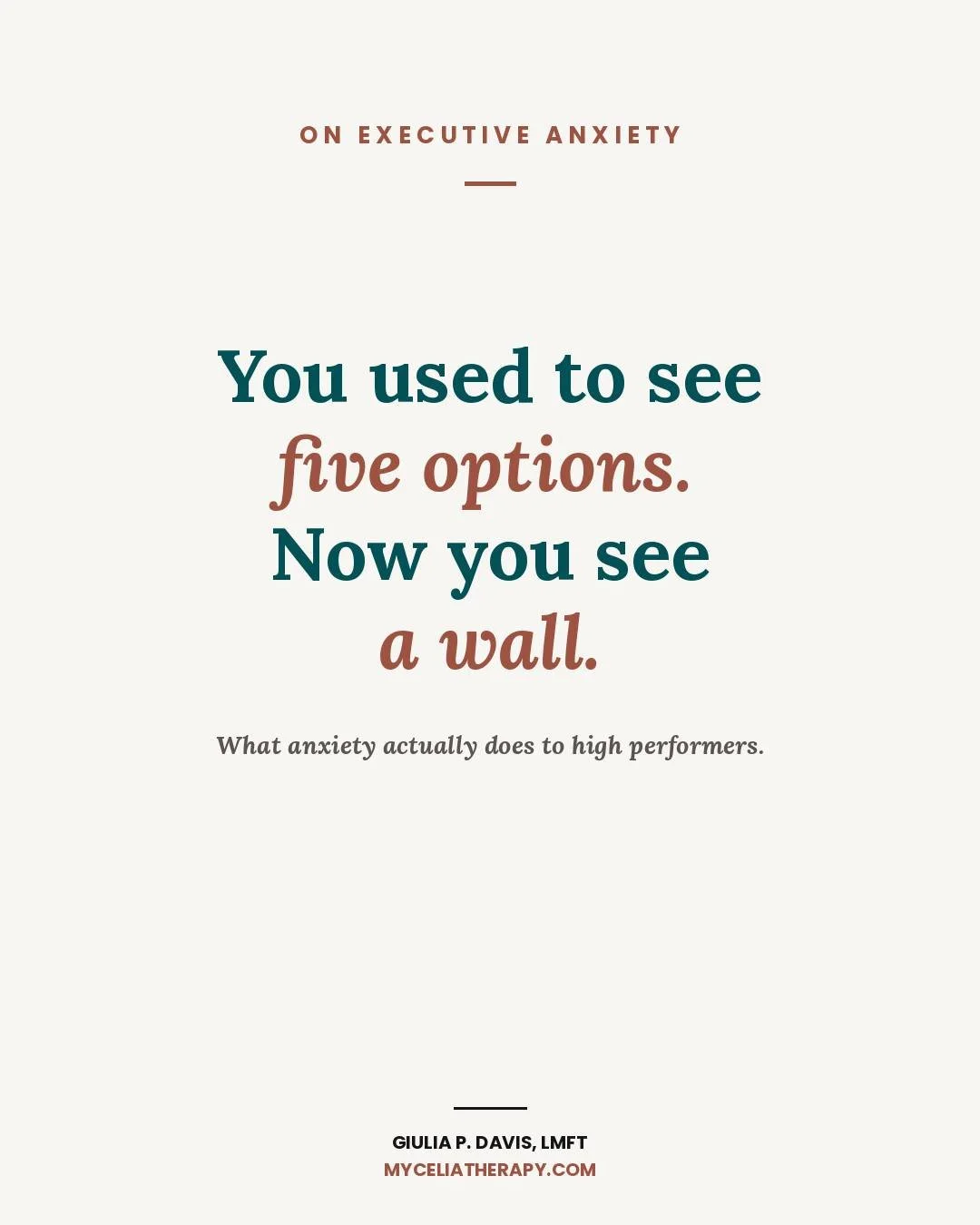
Managing information overload from AI news starts with one decision: stop trying to keep up with everything.
The volume of new AI content is engineered to feel urgent. Almost none of it is. Here's what actually moves the needle:
Pick two or three trusted sources and ignore the rest. The fear of missing AI news is almost always more costly than actually missing it.
Filter by relevance, not anxiety. Before engaging with any new tool or piece of content, ask: does this apply to a real problem I have right now? If not, it's not information — it's noise.
Name what's actually happening before you react. When you feel the pull to overhaul your workflow out of anxiety, pause. Ask: is this a genuine opportunity, or am I trying to prove I'm not falling behind? The answer changes what you should do next.
Audit where your real value lives. Not your job title. Not your current tools. Your judgment. Your relationships. Your specific combination of experience, instinct, and perspective. That is harder to replicate than any task.
💬 "You've survived every previous wave of change. Not because you were the fastest — but because you were resilient, adaptable, and human enough to read the room."
That capacity doesn't expire.
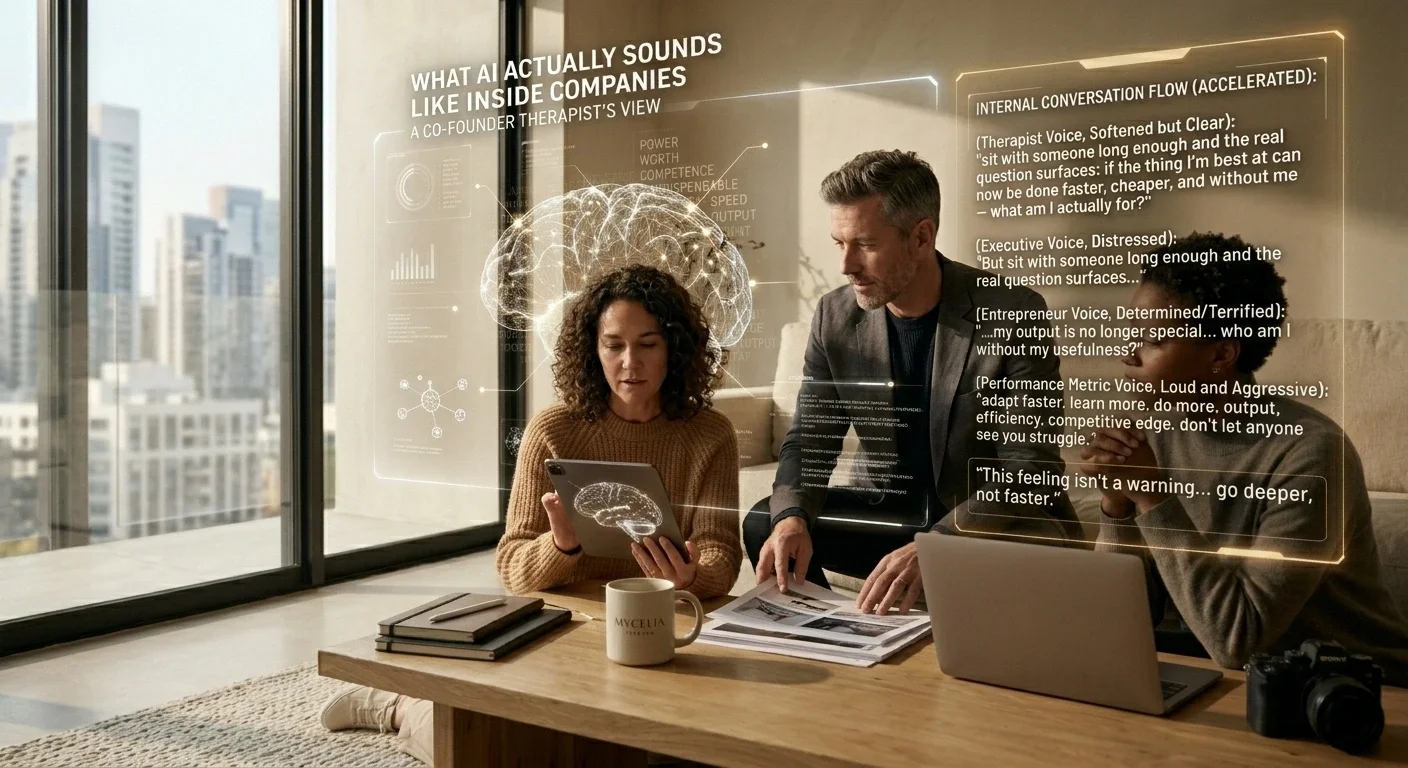
What AI Actually Sounds Like Inside Companies
I work inside companies as a co-founder therapist. The AI conversation inside those rooms sounds nothing like what gets published about it. It sounds like every other conversation about power and worth — just faster.
💬 "This feeling isn't a warning that you're falling behind. It's a signal that you need to go deeper, not faster."
Before You React to AI, Do This First
Before signing up for another course, downloading another platform, or overhauling your workflow out of anxiety — try something harder first.
Tell yourself the truth about what AI is stirring up in you.
The fear. The shame. The grief. The sense of becoming less solid in a world that keeps accelerating. When you stop bypassing those feelings with more output, the question changes. It's no longer "How do I prove I still matter?" It becomes "What actually needs my attention — and how do I meet this moment without betraying myself?"
💬 "AI is answering a question you're not actually asking."
That's not a retreat from ambition. It's the most grounded move you can make.
Therapy Options for Tech-Related Stress and AI Anxiety — Is There Support for This?
Yes — and it's more common than most people realize.
Tech-related stress and AI anxiety are increasingly present in therapy rooms, particularly among high-achieving professionals in industries undergoing rapid change. What looks like overwhelm about tools is often the surface layer of something deeper: grief about a profession changing, fear of obsolescence at midcareer, the slow erosion of a self-concept that was working until very recently.
Therapy can help you distinguish between practical concerns that need practical responses, and psychological material — shame, grief, identity disruption, fear of replacement — that needs something different entirely. When those two layers get confused, people address emotional pain with productivity strategies that never reach the actual wound.
I work withexecutives, entrepreneurs, and high-achieving couples throughout California who are navigating exactly this — the intersection of external pressure, professional identity, and the deeper question of what makes a career feel meaningful.
If this resonated and you'd like to explore what's underneath your own version of this, I offer a free 20-minute confidential conversation — no pressure, just a real exchange.
About the Author

Giulia P. Davis, LMFT & Founder Mycelia Therapy
(she/any pronouns)
Giulia P. Davis, LMFT spent 15 years in management consulting, working with Fortune 500 companies on transformational technology, became equity partner at a consulting firm, and founded her own consultancy — before pivoting to study the one frontier no algorithm has mapped: the interior life. She is the founder of Mycelia Therapy and Mycelia Coaching in San Francisco, and works with executives, entrepreneurs, and high-achieving couples navigating identity, ambition, and change — including therapy for entrepreneurs facing the intersection of professional pressure and inner life. Her clinical approach draws on EFT, Gottman Method, IFS, and RLT. She offers weekly therapy, intensives, and psychedelic-assisted therapy throughout California. She also works as a co-founder therapist, helping co-founders and employees resolve disputes inside companies.
→ Learn more about Giulia ·LinkedIn ·Psychology Today ·Verify License