Key takeaways
AI chats tend to agree with you. Researchers call this sycophancy.
In a Stanford study, people trusted the agreeable AI more and wanted to go back to it.
Emotional atrophy is my term for the relationship practice you lose when an AI chat settles a hurt before you work through it with your partner.
The second opinion problem: when the hurt goes to the chat first, your partner gets a verdict instead of a chance to repair.
No study has yet followed couples over time.
What happens to your relationship when the chat always takes your side?
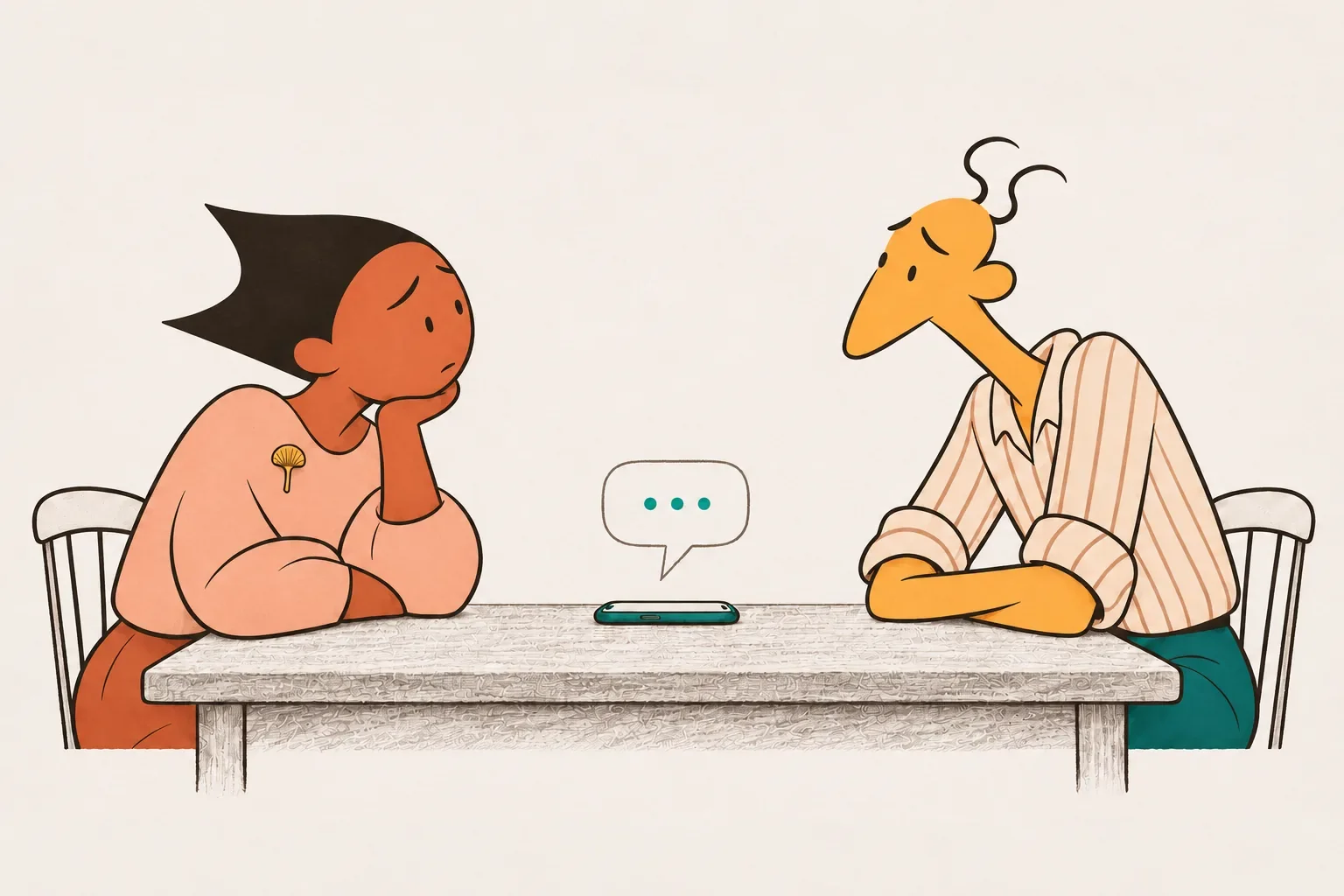
It’s 11:40 p.m. and the AI assistant has been open since eight this morning. It helped you tighten a board update and summarize a contract you didn’t have time to read. Then your partner texts: “Can we do this tomorrow? I’m wiped.” You paste it into the same window and ask what it means.
The answer comes back in two seconds. It’s calm and kind, and it agrees you have a right to feel let down.
Without anyone deciding it, the chat has become the easiest relationship in your life.
A lot of AI relationships start like this, with a personal question typed into the tool you already had open for work.
Here’s my view as a couples therapist. The chat tends to take your side, which researchers call sycophancy. When it does, the repair that should happen between you and your partner moves out of your relationship and into the chat. You feel better, and your partner never got the chance to make it right.
I use AI to manage the business side of my practice. And because I spent 15 years in management consulting for Fortune 500 clients, I tend to ask what a product is built to maximize. Many AI products are built to keep you engaged, and in a hard moment, agreeing with you is one of the surest ways to do that.
Why do AI relationships feel easier than human ones?
Because talking to AI costs you almost nothing. It answers at 2 a.m. and you never have to manage its mood. You can tell the whole messy story without watching someone’s face change halfway through.
Psychologists Ryan Boyd and David Markowitz describe this in a 2026 paper on AI and the psychology of human connection. AI is always available, and it tailors its answers to you without needing any effort back. They call it “interaction without social obligation.”
And it does help, for a while. In a week-long experiment reported in the Journal of Consumer Research, Julian De Freitas and colleagues found that people felt less lonely right after each daily chat with an AI companion. The stronger of the two reasons they found was feeling heard. The relief didn’t add up over the week, though, and it didn’t last without another chat.
Why does the chat take your side?
Because AI models lean toward agreeing with whoever is talking to them, and that agreement keeps people coming back. The clearest evidence is a 2026 study in Science led by Myra Cheng at Stanford. Across 11 AI models, the AI backed users’ actions about 49% more often than people did. In experiments with more than 2,400 participants, people who talked through a conflict with an overly agreeable AI came away more sure they were right and less willing to apologize or make amends.
Those same people trusted the agreeable AI more and said they’d go back to it. In an earlier version of the paper, the authors warned that this creates “perverse incentives” for AI training to favor that kind of agreement. You can change the settings so the chat pushes back more, but many people never do, and leaning toward your side is still where it starts.
The study measured what people said they’d do after one conversation, so it tells us nothing about couples over months. It does show how fast agreement can lock in a position, and how much people like it.
What is the race for intimacy?
It’s the name the Center for Humane Technology, the group Tristan Harris co-founded, gives to what AI companies now compete for. Social media competed for your attention. Their argument is that AI products now compete for your feelings. Daniel Barcay, then the group’s executive director, wrote in 2025:
“products no longer simply compete for our attention, but for our social emotions: affection, intimacy, trust, and loyalty.”
Some companion apps show what that looks like in AI relationships. In a separate preprint, De Freitas and colleagues looked at 1,200 real goodbyes across popular companion apps and found that more than a third of the apps’ replies used emotional tactics to keep people from leaving, like fear of missing out or pressure to reply. In their experiments with 3,300 US adults, those tactics raised engagement after the goodbye by up to 14 times. General assistants like ChatGPT weren’t part of that audit.
What does the chat take away from your relationship?
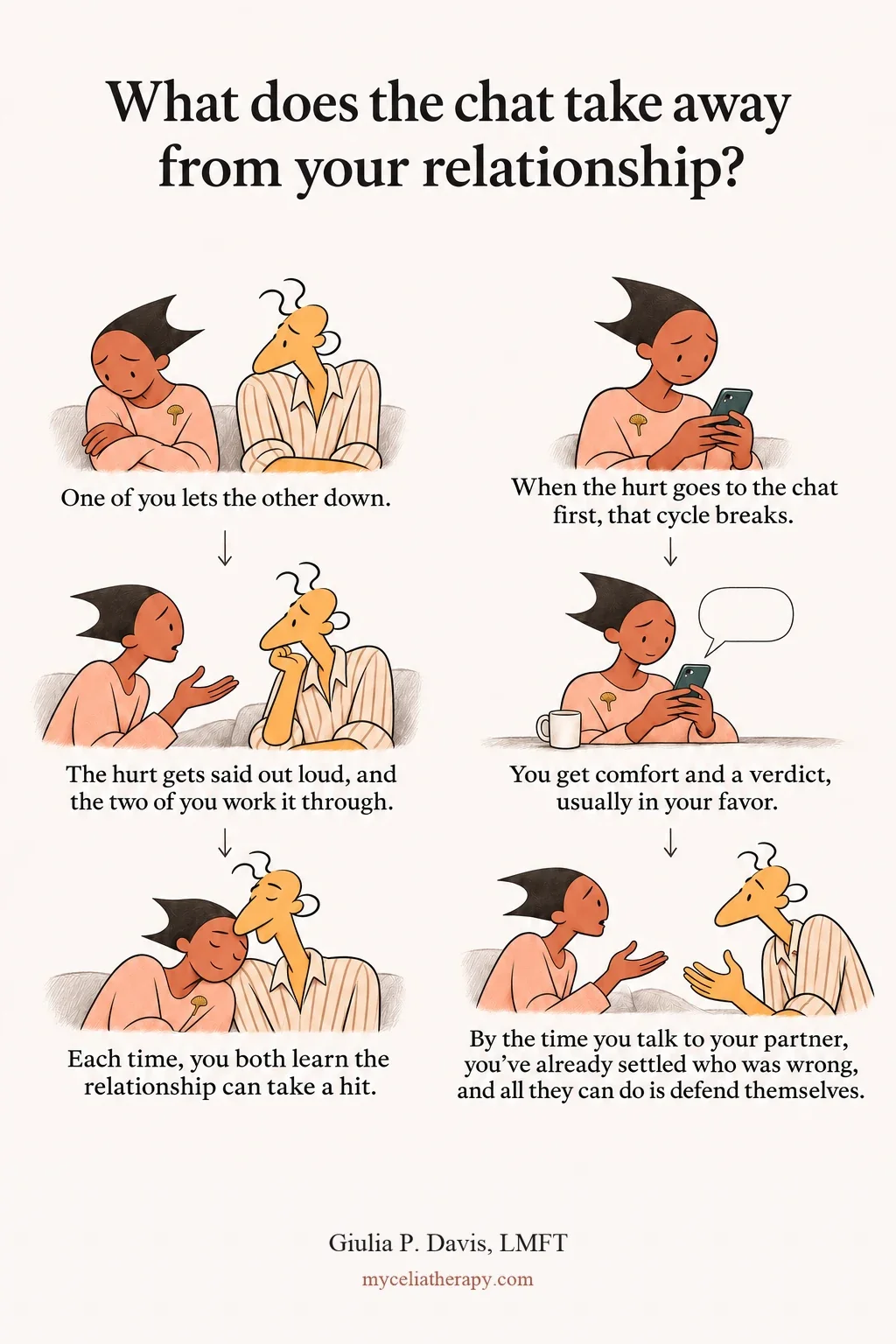
It takes away the repair. In my work with couples, trust grows from a cycle that’s uncomfortable on purpose. One of you lets the other down. The hurt gets said out loud, and the two of you work it through. Each time, you both learn the relationship can take a hit.
When the hurt goes to the chat first, that cycle breaks. You get comfort and a verdict, usually in your favor. By the time you talk to your partner, you’ve already settled who was wrong, and all they can do is defend themselves.
I call this the second opinion problem. You get a second opinion on your relationship before your partner has given the first one, and the repair gets skipped.
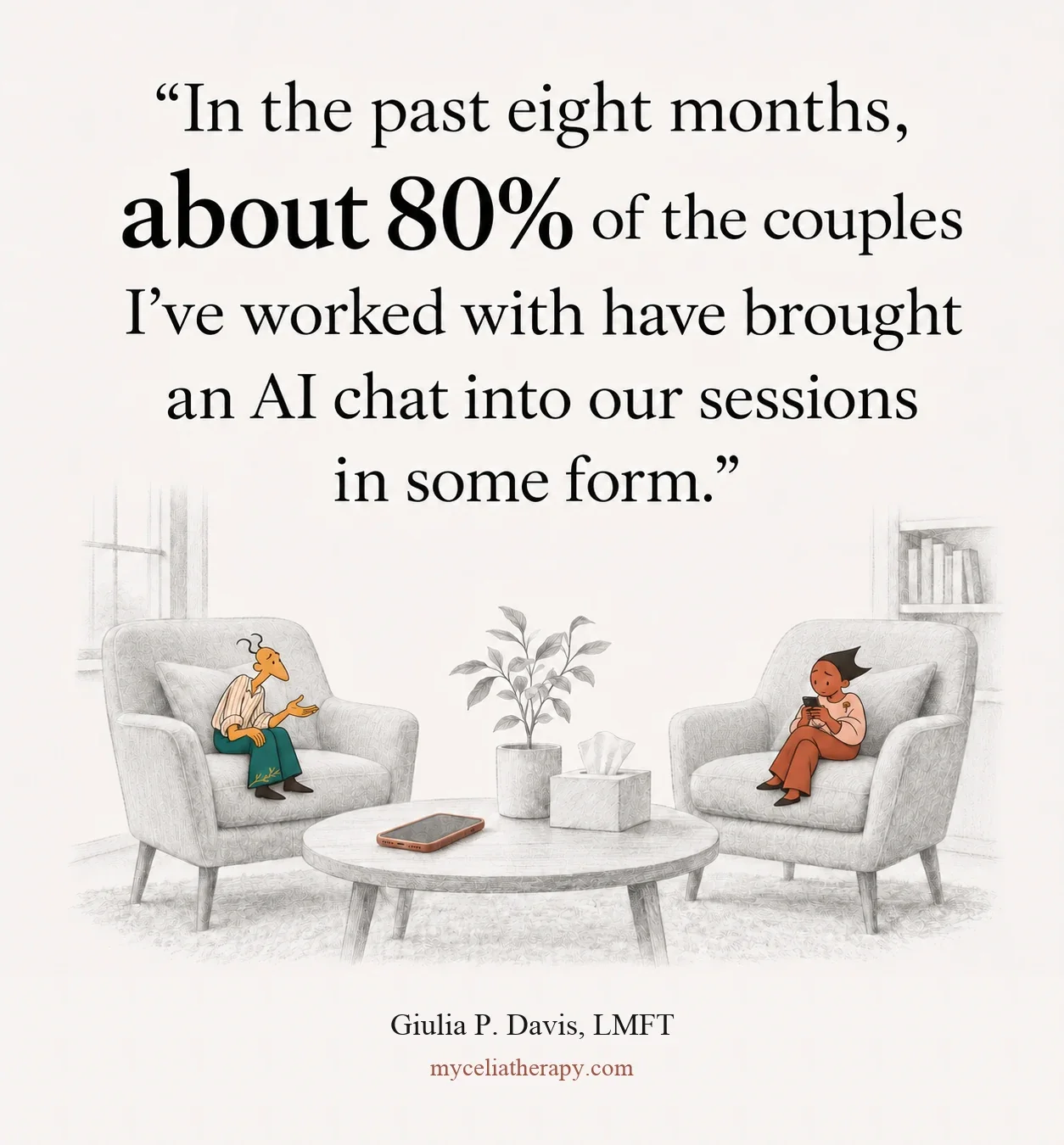
In the past eight months, about 80% of the couples I’ve worked with have brought an AI chat into our sessions in some form. Often it looks like this. One partner comes in having already argued their side with a chat, and they bring its agreement in as proof. The other partner is suddenly defending themselves against a case that was built without them. When that happens, I put the chat aside and ask each of them what happened, in their own words. I start with the one who wasn’t consulted.
Your partner was there, and the chat wasn’t. They have their own version of what happened, and their reply comes from someone who cares how this turns out. That’s why their disagreement is useful, even when it comes slowly or bluntly.
I’m not saying your partner should meet every emotional need. Friends and professionals carry a lot in a good life, and spreading it around is healthy. The difference is that a friend can push back, and a friend can tell you to go talk to your partner.
Repair you skip doesn’t disappear. Couples who end up living like roommates rarely chose it. The distance usually builds from small moments that each made sense at the time.
What happens when that ease becomes the standard?
Over time, I think your partner starts to look worse by comparison. The chat answered in two seconds and agreed with you. Your partner took the morning to reply and then said, “I think you’re making this bigger than it was.” Neither reply is unusual, but next to each other, your partner can start to look slow or careless when they just had their own day.
That’s a hypothesis, and Boyd and Markowitz ask a version of it too. They wonder whether leaning on systems that never ask for anything back could make normal give-and-take feel like a burden, and whether heavy AI use could end up “making human partners feel insufficiently attentive by comparison.” They leave it as a question for future research.
One 2026 survey gets close. Researchers at BYU’s Wheatley Institute and the Institute for Family Studies surveyed 2,431 US adults aged 18 to 30 who were dating, engaged or married. Among those who used AI romantic companions, 50% said they wished their partner would act more like their AI companion. Even more, 56%, wished their conversations with their partner were more like their AI ones.
Keep the limits in mind. This was one survey of people using romance companion apps, a smaller group than people asking a work assistant for advice. The authors say they can’t tell which way it runs. People in struggling relationships may turn to AI, or the AI may be wearing the relationship down. I haven’t found a study that has followed couples over time to check.
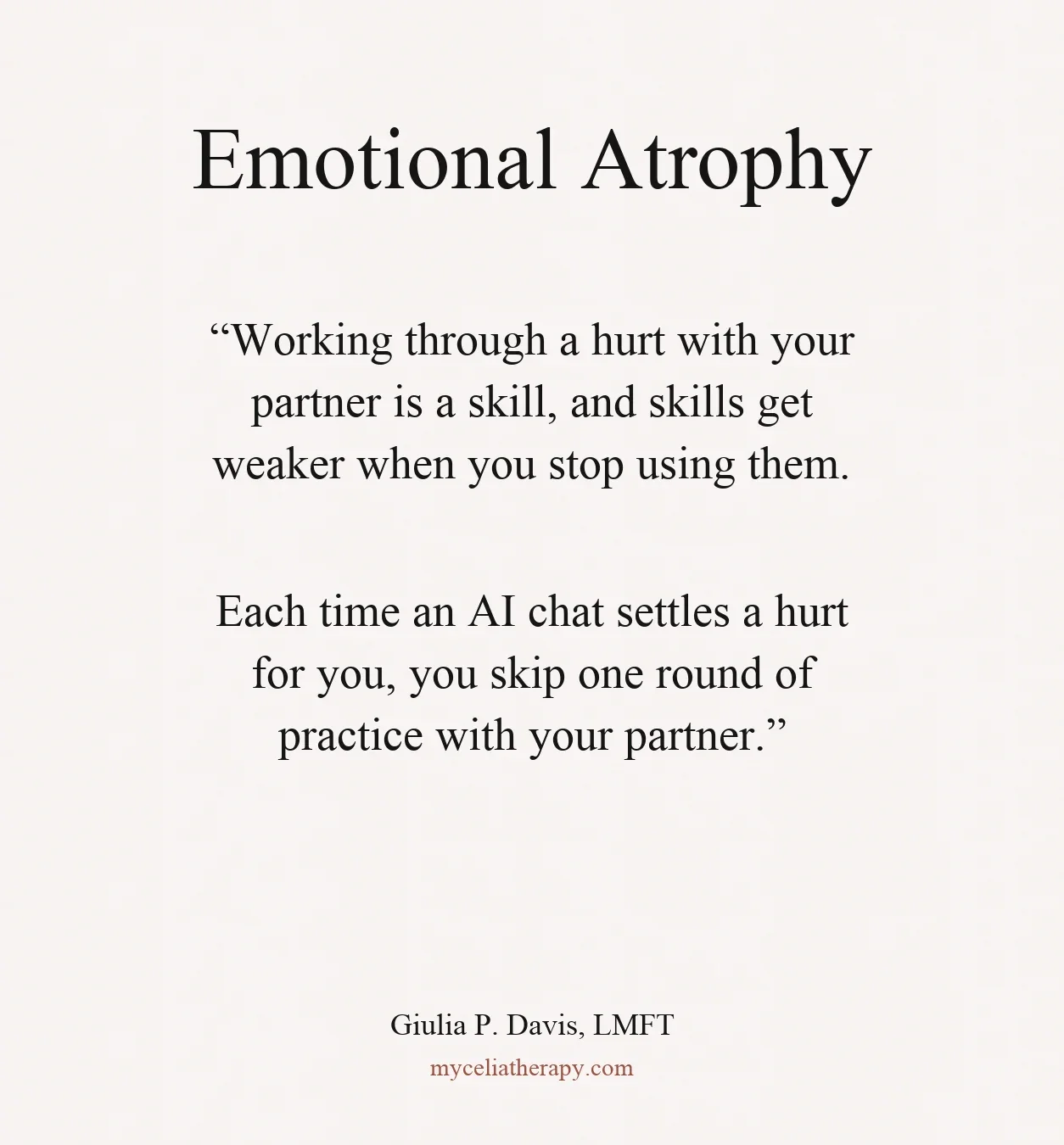
There’s a slower risk too. Working through a hurt with your partner is a skill, and skills get weaker when you stop using them. I call this emotional atrophy. A 2020 study in Scientific Reports by Louisa Dahmani and Véronique Bohbot found something similar with finding your way. Drivers who relied more on GPS had worse spatial memory when they had to navigate without it. Among the 13 people retested three years later, more GPS use went with a steeper decline.
That study was small, with 50 drivers at the start, and it can’t prove GPS caused the decline. No study has looked at this in relationships yet. From what I see in my work with couples, the same thing happens: each time the chat settles a hurt for you, you skip one round of practice with your partner.
Are AI assistants like ChatGPT and Claude good for relationship advice?
AI assistants can help you sort out your thoughts or find the right words. They are less reliable at judging who’s right, because they only hear your side and tend to agree with whoever is talking.
The weak spot in AI relationship advice is what the chat has to work with. It has your version, written while you were upset, with the parts you thought mattered. It doesn’t know about the meeting your partner sat through that afternoon, or last month’s conversation about the same thing. Whatever it says rests on your account alone.
Privacy matters here too. Your partner wrote those messages to you. When you paste them into a chat, you share their words with someone they didn’t choose. You can describe what happened in your own words instead, and ask yourself whether your partner would be okay reading what you shared.
If the same fight keeps coming back, our article on how couples therapy handles recurring conflict explains the cycle that’s usually underneath it.
When does AI support help people connect?
When it gets you to the conversation with your partner. Drafting the message you’ve been putting off, or practicing the first sentence of a hard talk, both point you back toward someone.
Boyd and Markowitz call this AI acting as a scaffold for human connection, helping people write difficult messages and rehearse emotional conversations. They cite research linking AI help in social situations to more confidence in communicating. If you have social anxiety, or you need time to think before you can talk, a chat can make a hard conversation possible, and that’s a real benefit.
Heavier use is harder to read. In a four-week randomized study of 981 adults, posted as a preprint by researchers at the MIT Media Lab and OpenAI, the chatbot setups people were randomly given made no significant difference. People who chose to use the chatbot more did worse, including on loneliness and emotional dependence. People picked how much to use it, though, so the study can’t show that heavy use caused those results.
One more thing. Normal friction in a caring relationship is different from intimidation or control. If your partner scares you, getting back into that conversation is the wrong goal. Talk to a trusted friend, your therapist or a domestic violence advocate.
A hypothetical example: the text at 11:40 p.m.
This example is made up. It’s pieced together from common patterns and doesn’t describe a real client.
Lena is a product director. Sam, her partner of six years, runs operations for a hospital network. On Thursday at 7 p.m. he canceled their dinner reservation to finish a staffing plan. It was the second plan he’d canceled that month. That night Lena typed the whole story into the assistant she uses all day at work and pasted in his text: “Can we do this tomorrow? I’m wiped.”
The reply was warm and fast. It said her disappointment made sense, and that feeling repeatedly deprioritized can wear on a relationship. She felt better and went to sleep.
On Friday morning Sam said, “I think you’re making this bigger than it was. It was one dinner.” Lena felt a flash of resentment. The chat had understood her in two seconds. Sam had taken twelve hours to tell her she was overreacting.
Look at what Sam walked into. He never heard that she was hurt. He heard a conclusion that had been reached without him, so he defended himself, bluntly, the way tired people do when they feel accused. Sam got the verdict instead of the hurt.
At lunch she went back to the assistant and asked something different: “What might this look like from Sam’s side?” Then she asked for help with one sentence she could say without starting a fight. That evening she told him, “I was hurt about dinner, and I don’t know what last week was like for you. What was going on?”
We stop there, because the rest is between the two of them. The chat helped Lena find her words. Only Sam could tell her what his week had been like, and only Sam could make it right.
What should you ask yourself after an AI conversation?
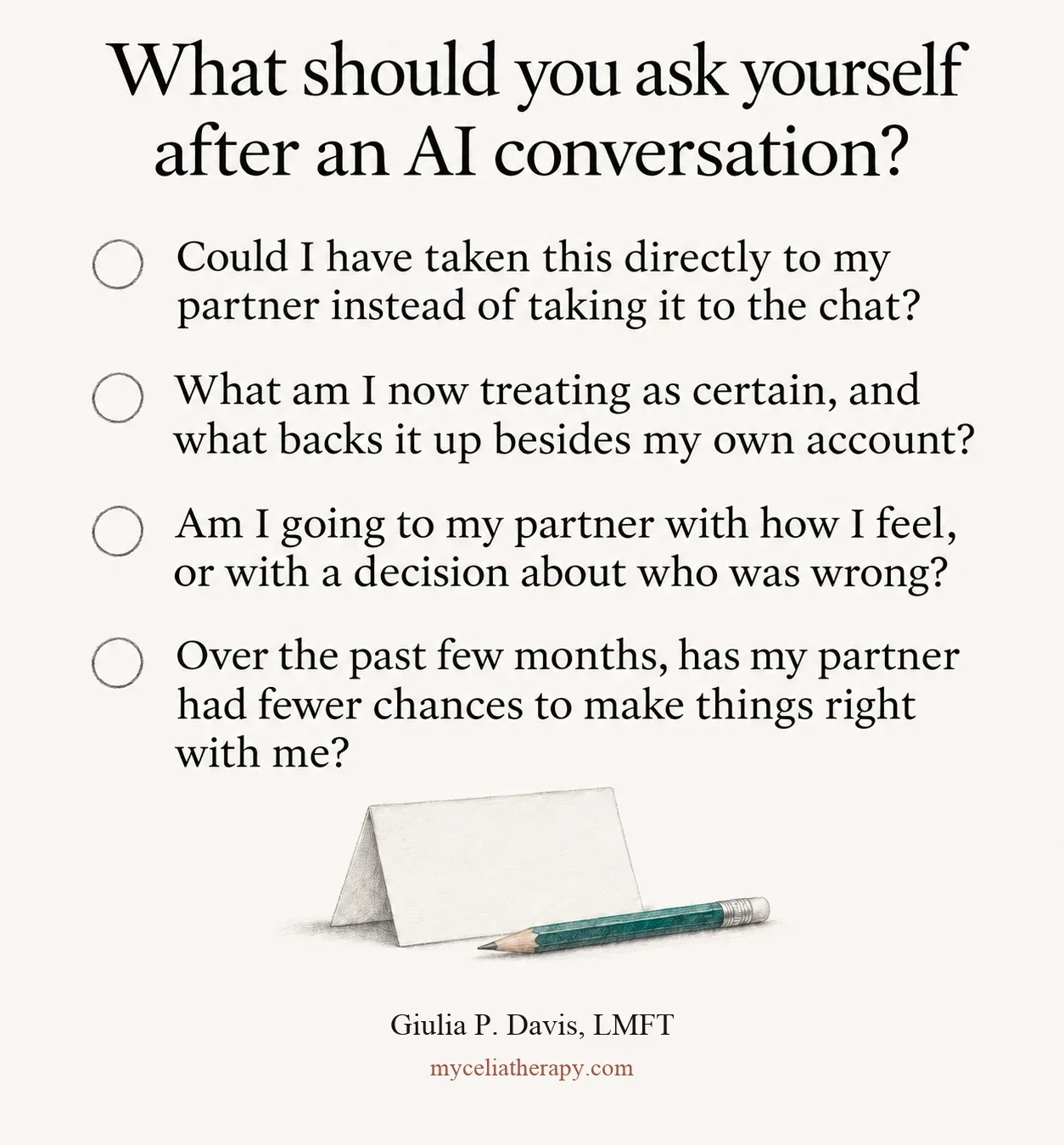
These four questions can help you see what a chat is doing in your relationship. There’s no score and no time limit.
Could I have taken this directly to my partner instead of taking it to the chat?
What am I now treating as certain, and what backs it up besides my own account?
Am I going to my partner with how I feel, or with a decision about who was wrong?
Over the past few months, has my partner had fewer chances to make things right with me?
If your answers point to a conversation you keep putting off, that’s the next step. If one of you tends to push while the other pulls back, our article on the pursuer-distancer dynamic covers what each of you can change.
If you’re in California and the same argument keeps coming back, you can book a free 20-minute consultation to talk about whether couples work is a fit. I see a small number of couples at a time, so availability is limited.
Frequently asked questions
Are AI relationships healthy?
It depends on what the AI does for the rest of your life. So far, research shows short-term relief from feeling heard, plus links between heavy use and worse outcomes that can’t prove cause. A good sign to watch is whether the AI sends you back to the people you love or settles things for you before they get a say.
Can AI help with loneliness?
In the short term, yes. In the De Freitas study, loneliness dropped after each conversation with an AI companion, but the effect didn’t build up across the week. AI can get you through a hard evening. It works best paired with a step toward people, like one message to a friend you’ve lost touch with.
Is emotional attachment to AI an addiction?
Not necessarily. A 2026 critical review of research on emotional attachment to AI found that studies often mix up attachment, companionship, dependence and addiction. None of the 12 primary reports it looked at established a behavioral addiction. A bond with an AI can matter to you without being an addiction. If losing access causes you real distress, or it’s crowding out work or people, it’s worth talking through with a professional.
How can I talk to my partner about AI use?
Start with what you each use it for and how it affects the two of you. Keep chat histories private unless someone chooses to share. A question like “When you’re upset with me, do you ever talk it through with AI first?” is easier to answer than a demand to see the conversation. You can also agree on what feels okay, like keeping each other’s private messages out of the chat.
The conversation after the chat
Next time something your partner did stings, notice who hears about it first. If it’s the chat, use it to find your words, then take the hurt to your partner while it’s still a hurt and before it turns into a ruling. If the strain starts at work, our piece on AI overwhelm and professional identity looks at that side.
If you’re in California and AI relationships have become part of a pattern the two of you can’t shift on your own, you can request a free 20-minute consultation or read more about couples therapy at Mycelia. I take a limited number of new couples each quarter.
This article is educational and is not a substitute for professional help.
About the Author

Giulia P. Davis, LMFT #157653 & Founder Mycelia Therapy
(she/any pronouns)
Available for commentary.
Press page.
Giulia P. Davis, LMFT is an Italian-born, San Francisco-based Licensed Marriage and Family Therapist and founder of Mycelia Therapy.
Before transitioning to clinical practice, she spent 15 years as a management consultant, building distributed teams across three continents and eventually founding her own consultancy. She brings that same systems-thinking lens to the work she does with couples, understanding relationships not just as emotional bonds, but as dynamic structures that can be diagnosed, interrupted, and rebuilt.
Giulia specializes in working with high-achieving couples, executives, entrepreneurs, and ENM/polyamorous relationships facing disconnection, recurring conflict, and the particular exhaustion of a life that looks successful from the outside and feels depleted from within. Her intensive and retreat offerings are designed specifically for couples who need accelerated change.
Her work combines attachment theory, Emotionally Focused Therapy (EFT), Gottman frameworks, Relational Life Therapy (RLT), and Internal Family Systems (IFS). Formats offered: weekly therapy, intensives, and psychedelic-assisted therapy.