The offer from the Austin office has been in your inbox for six days, and you’ve brought it up three times. On Sunday at 9:40 p.m. you try a fourth. Your partner says, “Can we do this after my board deck goes out Wednesday?” and opens the laptop, and when you follow them to the sofa with one more question, the answers get shorter.
Two weeks later your partner wants to talk about your travel. You were away eleven nights last month. This time you’re the one saying, “I’m slammed, can it wait?”
Couples therapists call this the pursuer-distancer dynamic. One partner presses for contact or a decision, the other pulls back, and each move makes the other more likely.
Many couples also trade roles, as in the second scene. In my experience the partner who wants something to change usually pursues, and the partner being asked to change usually withdraws. The same two people can switch places within a month.
Before I became a couples therapist, I spent 15 years in management consulting for Fortune 500 clients. Stalled decisions there often had the same two sides: one person sending follow-ups and another holding off until they had a complete answer.
I now work with high-achieving couples in San Francisco and across California. This loop usually loosens once each partner knows which part of it they can change.
Key takeaways
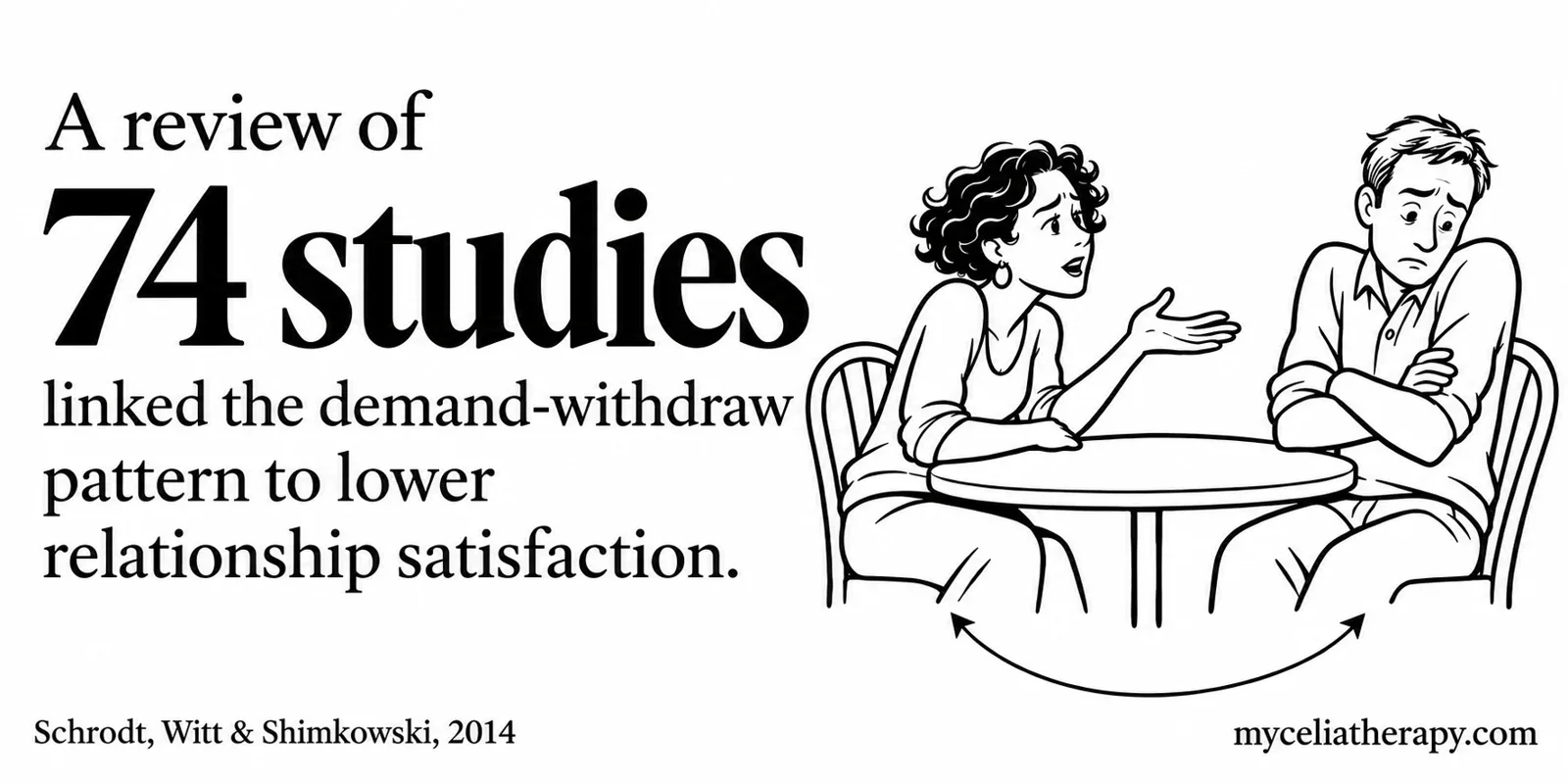
The pursuer-distancer dynamic is a loop between two people. Researchers call it the demand-withdraw pattern, and a review of 74 studies linked it to lower relationship satisfaction.
Roles often follow the topic. Whoever wants the change tends to pursue.
Each partner can change their own half. Both can say what sits under their move. The pursuer makes one clear request, and the distancer comes back at the time they named.
Threats, control and fear are a different problem from this cycle and need different help.
California-based couples can book a free 20-minute consultation.
What is the pursuer-distancer dynamic?
The pursuer-distancer dynamic is a repeating conflict pattern. One partner moves toward the other for answers or reassurance, and the other moves away to get space or calm down. The more one pursues, the more the other withdraws, and the reverse is true too.
In research it is called the demand-withdraw pattern, and it has been studied widely. A 2014 review by Paul Schrodt and colleagues of 74 demand-withdraw studies covered more than 14,000 participants. The pattern was consistently associated with lower relationship satisfaction.
The association was about as strong whichever partner did the demanding. Most of the studies were correlational, so they show that the pattern and unhappiness travel together. They can’t show which comes first.
Therapists trained in Emotionally Focused Therapy (EFT) usually say pursuer and withdrawer. Sue Johnson, who co-developed EFT, called this cycle the Protest Polka in her book Hold Me Tight.
In daily life, pursuing looks like a third text in an hour, or following someone into the next room with one more question. Distancing looks like “Fine,” or another hour at the laptop. Each of you can describe the loop as a reaction to the other person, and each description is accurate.
You’ll also see this called the anxious-avoidant trap. The two ideas overlap and are worth keeping apart. Attachment style describes how one person tends to handle closeness across relationships.
The pursuer-distancer dynamic describes what two people do in a particular argument. Someone with a secure attachment style can still pursue hard on a subject that matters to them. If you want the wider picture, our article on how couples therapy handles recurring conflict covers the cycle that sits underneath most repeat arguments.
Why does one partner seek more contact while the other pulls away?
One partner seeks contact and the other pulls away because they want different things from the same tense moment. The pursuer wants the issue settled or the connection back, and silence feels like the problem growing. The distancer wants the pressure lower so they can think, and more questions feel like the problem growing.
Both of you are trying to make the argument smaller, and which subject is on the table shapes the roles. In a 1993 study by Christopher Heavey, Christopher Layne and Andrew Christensen, 29 married couples held two recorded discussions. One was about a change the wife wanted, and one was about a change the husband wanted.
Wives demanded more and husbands withdrew more when the wife’s issue was on the table. When the husband’s issue was discussed, that gender difference disappeared. It is a small, older study of heterosexual married couples, so it can’t tell us how often this holds for everyone.
Swap the topic and many couples swap roles. The partner who keeps raising the move to Austin can be the one who goes quiet about the travel calendar.
I use the labels carefully. Calling one partner “the pursuer” and the other “the distancer” can turn a pattern into a personality, and then the argument becomes about who is the problem. I find it more useful to ask, in each argument, who wants something to change and who is being asked to change.
Demanding careers give both moves a respectable cover. Pursuing sounds like ordinary professionalism: you need an answer by Friday because the recruiter needs one by Friday. Distancing sounds like a full calendar: the deck, or the late call with Singapore.
The same loop runs through many fights about money and jobs, where one partner wants a plan and the other wants the subject to rest.
How can both partners interrupt the cycle?
Both partners interrupt the cycle by naming it together and saying what sits under their own move. In EFT, the first goal is for both partners to see the cycle as the problem. The withdrawing partner then re-engages, and the pursuing partner softens.
A 2016 review of EFT research by Stephanie Wiebe and Sue Johnson, published in Family Process, describes what is usually underneath. Withdrawal is often driven by a fear of failing or being rejected. A pursuer’s blame often covers hurt or fear.
When each partner says that part out loud, the other has something they can respond to. In the EFT model, the withdrawing partner’s re-engagement usually comes first and the pursuing partner’s softening follows.
If you tend to pull away
Say what’s happening under the silence, in one sentence: “When the questions speed up, I start to feel like whatever I say will be wrong.”
If you need a pause, give a time: “I need twenty minutes, and I’ll come find you at 8:30.” Then keep it.
Come back even if you only have a partial answer. “I don’t know yet, and here’s what I’m stuck on” counts.
Tell your partner what helps you stay, such as one question at a time.
If you tend to pursue
Say what’s under the push: “I keep asking because I’m scared I’ll be deciding this alone.”
Make one request with a time attached: “Can we talk about Austin for half an hour tonight, or tomorrow at lunch?”
When your partner asks for a pause, let them go. Skip the texts and the questions through the office door.
When they come back, ask where they’ve landed before you make your case.
“I need a break” can sound like the conversation is over. “I need twenty minutes, and I’ll find you at 8:30” is a plan your partner can wait for.
A partner who leaves and never returns to the subject teaches the pursuer that the only way to get an answer is to press harder. Coming back at 8:30 with an honest half-answer shows them that waiting works.
A hypothetical example: the Austin offer
This example is hypothetical. It is assembled from common patterns and does not describe a real client.
The problem. Nadia, a product executive, has a job offer in Austin and a Friday deadline. Sam, a law firm partner, keeps saying they’ll talk after his filing.
On Sunday night Nadia follows him from the kitchen to the sofa with questions. Sam says, “You always do this,” and leaves for a run. They spend Monday morning being polite.
The pursuit. The next night, as the conversation heats up, Sam tries something different. “I’m too wound up to think. Give me until 8:30, and I’ll come to the living room.”
Nadia doesn’t text him. She writes one sentence on her phone instead: “I need to know whether you’d ever consider moving, before I answer them on Friday.”
At 8:25 Sam comes back. “When you came at me with questions last night, I felt like any answer I gave would be the wrong one.”
“I don’t want to move before my partnership vote in March. After that I’m open, and I want us to look at the numbers together.”
Nadia tells him she kept pushing because she was scared of deciding alone. Then she asks what the numbers would need to show.
The payoff. They don’t decide that night. They set Thursday at 7 p.m. to go through the numbers, and Nadia asks the recruiter for an extra week.
Sam came back at the time he named and said what had made him leave. Nadia said what had made her push.
What happens when the pursuer stops pursuing?
What happens when the pursuer stops pursuing depends on why they stopped. If they stepped back on purpose and still say what they need, the withdrawing partner often has room to move toward them. If they stopped because they gave up, the arguing fades and the distance grows.
Sue Johnson called the pattern where both partners pull back Freeze and Flee. EFT therapists sometimes describe the partner who has stopped trying as a burned-out pursuer. That partner can be harder to reach than one who is still asking, so the quieter stage deserves more attention than the arguing did.
The withdrawing partner often reads the quiet as improvement at first, since there are fewer hard conversations and evenings feel easier. Meanwhile the former pursuer may have started making plans on their own and saying “It’s fine” about things that used to matter.
Some stop mentioning the subject at all. Couples in this stage often describe themselves as living like roommates.
Stepping back on purpose looks different. It means fewer requests, each one clear, and still saying what you feel.
When the partner who always asked stops asking, find out whether they’ve made peace or given up. The house can look the same either way.
How can AI relationship advice affect the cycle?
AI can help you find words before you go back into a conversation. It can also keep the loop going by agreeing with your account. A chatbot hears only the version you type, and research suggests many models lean toward telling the asker they’re right.
In a 2026 Science study led by Myra Cheng at Stanford, 11 AI models affirmed users’ actions about 49% more often than people did. In experiments with more than 2,400 participants, people who discussed a conflict with an overly agreeable AI became less willing to apologize or make amends. They also grew more convinced they were right, though the study measured stated intentions only.
In a 2026 Frontiers in Psychology experiment with 380 adults, two AI response styles gave similar relief. People who got help choosing their own next step coped better on a later task without AI. Long-term dependence was not measured.
No study has tested AI on this cycle, so the rest is my clinical interpretation, based on EFT. Under a pursuer’s questions there is usually a simpler one: are you there for me?
A chatbot can guess at a partner’s silence. Only the partner can answer that question. A withdrawer who rehearses with AI may be hunting for an answer that can’t be wrong, which feeds the fear of failing.
Ryan Boyd and David Markowitz separate AI as a companion from AI as a go-between for two people. As a go-between, it can help you put what you feel into one sentence.
When is it something other than a pursuer-distancer cycle?
A pursuer-distancer cycle is reciprocal. Both partners are uncomfortable, and either one can say no without being afraid of the other. It is a different situation when one partner uses fear or control: threats, checking the other’s phone, blocking a doorway, punishing the other for taking a break, or using days of silence as punishment.
Break agreements and communication exercises are the wrong tools for that, and joint sessions are not always safe. If any of this sounds familiar, the National Domestic Violence Hotline offers free, confidential support at 1-800-799-7233, or by texting START to 88788.
Assessing for coercion and abuse is part of my work with every couple, including in the separate meeting I hold with each partner early on.
When can couples therapy help?
Couples therapy helps when you can both describe the loop and still can’t stop it once an argument starts. It also helps when one partner has gone quiet and the other hasn’t noticed. A therapist slows the sequence down so each of you can see your own move as it happens and practice a different one.
I work mainly with EFT. We map your cycle first and slow it down, then work on the moments when the withdrawing partner re-engages and the pursuing partner softens.
My process starts with a free 20-minute consultation, then a joint intake with both of you. After that I meet with each partner once on their own to understand how the goals you share as a couple fit with each person’s own goals.
For couples whose calendars rarely allow a weekly hour, intensive couples therapy compresses that work into one to three days, in San Francisco or online. If you’re comparing options, these questions to ask before you book a couples therapist can help you test fit for both of you.
If you’re in California and the same argument keeps coming back, you can book a free 20-minute consultation to talk through whether this work fits. I keep a small number of couples at a time, so availability is limited.
Frequently asked questions
Is the pursuer-distancer dynamic the same as an anxious-avoidant relationship?
They overlap without being the same. Anxious and avoidant are attachment styles, which describe how one person tends to handle closeness. The pursuer-distancer dynamic describes what two people do in an argument. Partners with any attachment style can fall into it, especially on a topic that matters to one of them.
Is the distancer the one causing the problem?
Each partner’s move sets off the other’s, and the research on the demand-withdraw pattern finds it is linked to lower satisfaction whichever partner demands. The distancer does have something specific to do: say what sits under the silence, and come back at the time they named. In EFT, helping the withdrawing partner re-engage is usually an early step.
How long should a break during an argument last?
At least 20 minutes. The Gottman Institute recommends that minimum, and it matches what I see in my practice. Some people need up to a day, and what matters most is a scheduled time to come back to the conversation.
Can we break the pursuer-distancer cycle without therapy?
Many couples can, especially when both partners agree on how breaks will work and keep the return time. Couples therapy is worth considering when the loop keeps winning despite good intentions, or when one of you has stopped trying.
What if my partner won’t come back to the conversation?
Raise it at a calm moment, outside the argument, and ask for one agreement: a break always ends with a time. If your partner still won’t return to hard subjects, a couples therapist can help you look at what makes coming back feel unsafe or pointless for them.
The pursuer-distancer dynamic holds two reasonable people in a loop, and the roles often follow the topic more than either personality. If each of you takes your own half, saying what sits under your move and coming back when you said you would, the argument has a way to end.
If you’re in California and want help with it, you can request a free 20-minute consultation. I take a limited number of new couples each quarter.
This article is educational and is not a substitute for professional help.
About the Author

Giulia P. Davis, LMFT #157653 & Founder Mycelia Therapy
(she/any pronouns)
Giulia P. Davis, LMFT is an Italian-born, San Francisco-based Licensed Marriage and Family Therapist and founder of Mycelia Therapy.
Before transitioning to clinical practice, she spent 15 years as a management consultant for Fortune 500 clients, building distributed teams across three continents and eventually founding her own consultancy. She brings that same systems-thinking lens to the work she does with couples, understanding relationships not just as emotional bonds, but as dynamic structures that can be diagnosed, interrupted, and rebuilt.
Giulia specializes in working with high-achieving couples, executives, entrepreneurs, and ENM/polyamorous relationships facing disconnection, recurring conflict, and the particular exhaustion of a life that looks successful from the outside and feels depleted from within. Her intensive and retreat offerings are designed specifically for couples who need accelerated change.
Her work combines attachment theory, Emotionally Focused Therapy (EFT), Gottman frameworks, Relational Life Therapy (RLT), and Internal Family Systems (IFS). Formats offered: weekly therapy, intensives, and psychedelic-assisted therapy.