Is a Couples Therapy Intensive Worth It?
High-achieving couples are used to making expensive decisions with incomplete information. They look at the problem, the timing, the people involved, and what will happen after the first push. When the relationship is under strain, that discipline can disappear. The wish to do something quickly starts driving the decision.
I spent 15 years in management consulting for Fortune 500 clients before becoming a couples therapist. High-performing couples often arrive with a familiar proposal: weekly therapy will move too slowly, so an intensive must be the efficient choice. Sometimes they are right. Sometimes speed is being used to avoid a harder question about readiness.
Key Takeaways
• A couples therapy intensive may be worth it when both partners want focused work, the central pattern is clear enough to target, and uninterrupted time is the main constraint.
• Research supports couples therapy overall. Direct evidence proving intensive scheduling outperforms weekly therapy for most couples is limited.
• Screening, therapist fit, safety, and follow-up matter more than promises about compressing months of work into a weekend.
• An intensive should produce a usable plan for what comes next. Insight without practice rarely holds.

Is a Couples Therapy Intensive Worth It?
For the right couple, a couples therapy intensive can be worth the cost because it creates enough continuous time to identify a stuck pattern, work with it while it is present, and build a plan for continued repair. It is a poor investment when one partner is being pushed into it, safety has not been assessed, or the provider sells certainty the evidence cannot support.
A 2020 meta-analysis of 58 studies involving 2,092 couples found that couple therapy had a large effect on relationship satisfaction and meaningful effects on communication, intimacy, and partner behavior. This is strong support for couple therapy overall. Because the study included multiple approaches and formats, it does not show that a weekend intensive is broadly superior to weekly sessions.
A later review of couple therapy in the 2020s reached a similar conclusion about the field: established couple treatments reduce relationship distress, while access, tailoring, and real-world delivery remain important questions.
The honest answer is qualified. Evidence supports doing good couples work. The decision about format depends on your goals, stability, schedule, and willingness to keep working after the concentrated session ends.
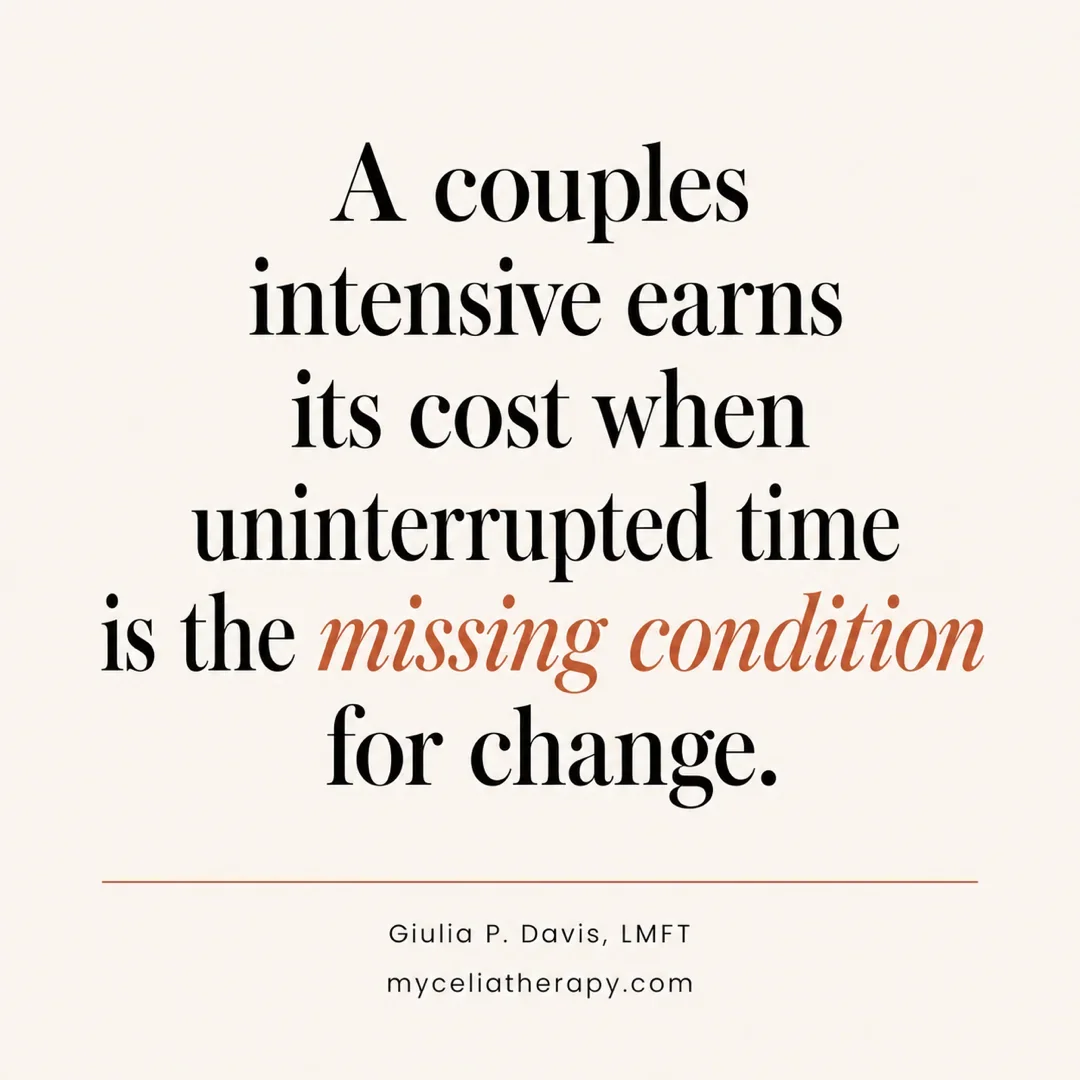
A couples intensive earns its cost when uninterrupted time is the missing condition for change.
What Are You Paying For in a Couples Therapy Intensive?
You are paying for continuity, preparation, focused clinical attention, and a defined arc of work. The hours are useful when the therapist screens carefully, structures the time around clear goals, sets an appropriate pace, and plans for integration afterward.
In weekly therapy, you have time between sessions to test new behavior and return with information. That slower rhythm serves many couples well. It also creates friction for couples whose travel, leadership demands, or recurring crises repeatedly break momentum.
An intensive reduces that fragmentation. A therapist can see a pattern unfold, interrupt it, help both partners understand what drives it, and practice a different response without stopping simply because the appointment has ended. The uninterrupted time allows a difficult conversation to continue long enough for both partners to understand what keeps happening between them.
Couples Therapy Intensive vs. Weekly Therapy
Weekly therapy
Works well when: You want a gradual pace and time to practice.
What it offers: Regular support as changes develop at home.
Consider: Sessions may end before you reach the central pattern.
Intensive therapy
Works well when: Both partners are ready to focus on a defined issue.
What it offers: Uninterrupted time to understand and work with the pattern. Uninterrupted time allows a couple to understand the pattern while it is happening and practice a different response before the session ends.
Consider: Longer sessions require thoughtful pacing and breaks.
Hybrid approach
Works well when: You want concentrated work followed by continued support.
What it offers: Initial momentum plus help applying the work at home.
Consider: The intensive and follow-up care need a clear plan.
If you want a fuller description of Mycelia's formats, read the benefits and structure of intensive couples therapy.
When Does an Intensive Make Sense?
An intensive makes sense when both partners have enough willingness and stability to use concentrated time well. “We are too busy for weekly therapy” is relevant, but it does not answer the clinical question.
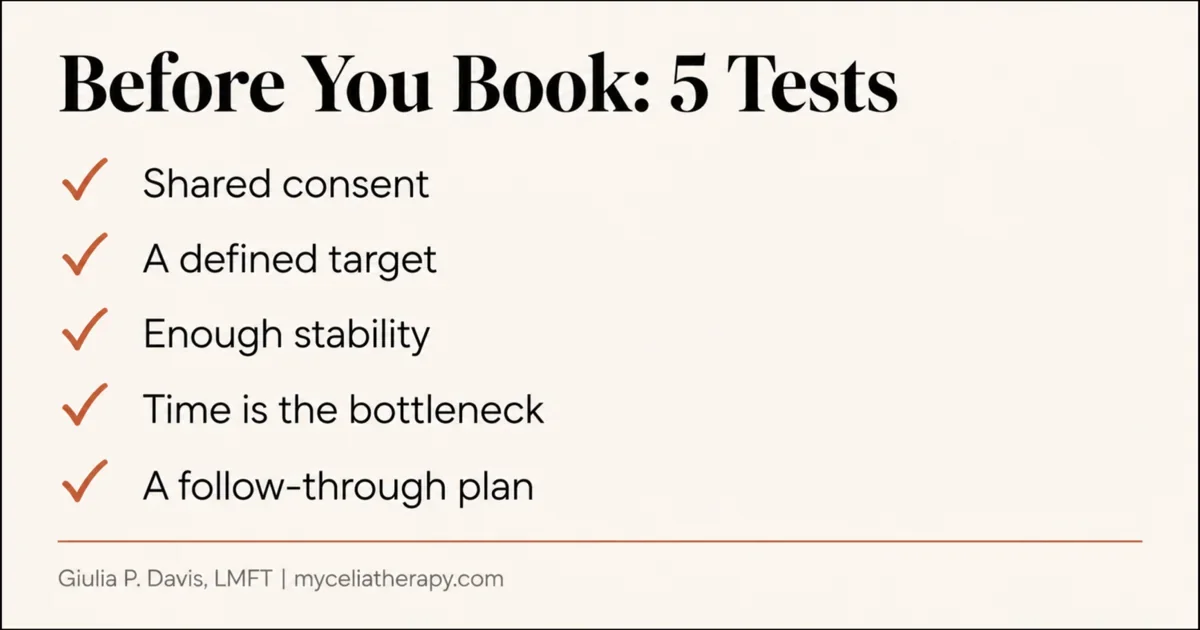
Use these five questions before booking:
1. Do both of us consent to the format?
One partner can be more enthusiastic. Both need enough agency to participate, disagree, pause, and speak candidly.
2. Can we name the pattern we want to address?
You do not need a perfect diagnosis of the relationship. A workable target might be the same fight about work, repeated withdrawal after conflict, the fallout of a disclosed betrayal, or a decision you cannot make together.
3. Are we stable enough for concentrated work?
An intensive asks for sustained attention. Sleep deprivation, unmanaged substance use, acute psychiatric symptoms, and immediate safety concerns often call for a different sequence of care.
4. Is time the main bottleneck?
Some couples understand their pattern but cannot stay with it long enough to change their response. Others need the slower feedback loop of weekly work. Be precise about which problem you are buying the format to solve.
5. Is there a follow-through plan?
Ask how the work will be consolidated, what you will practice, when follow-up occurs, and how your existing therapists will be involved if relevant.
Your schedule belongs in this assessment alongside the clinical questions. I want to know why weekly work has been difficult, what keeps interrupting the process, and whether concentrated time would help us stay with the central pattern long enough to understand it.
If you are comparing formats, I offer a free 20-minute consultation for California-based couples. I keep intensive availability limited so each case receives appropriate preparation and follow-up.
When Is a Couples Therapy Intensive Not Appropriate?
I do not offer couples therapy, when there is current violence. Joint sessions are also inappropriate when one partner fears retaliation or cannot speak freely because of coercive control.
The National Domestic Violence Hotline advises against couples therapy when abuse is present because shared sessions can increase risk and imply mutual responsibility for abusive behavior. Private safety planning and individual support need to come first.
Active addiction and acute psychiatric instability also require other care before couples work begins. A major disclosure that is still unfolding may call for slower assessment so both partners have enough information and stability to decide what they are working toward.
An ongoing affair also needs careful assessment. The question may be whether enough truth and basic stability exist for joint work. A good provider should be willing to recommend a different starting point rather than force every couple into the same offer.
The same applies when one partner views the intensive as a final ambush: “Agree with me this weekend or the relationship is over.” Discernment work, individual support, medical care, substance-use treatment, or weekly couples therapy may be a better first step.
If the setting is unsafe, longer sessions increase exposure rather than improve treatment.

What Should You Ask Before Booking?
Ask questions that reveal how the therapist thinks, screens, and plans. Credentials matter. So does the provider's willingness to tell you when the format does not fit.
Ask:
• What happens before the intensive? Are there joint and individual assessments?
• What goals will we define, and how will we know the time was used well?
• Which couples therapy approaches inform your work?
• How do you pace breaks, meals, and emotional intensity?
• How do you screen for violence, coercion, active addiction, and acute mental health concerns?
• What are the confidentiality rules for individual conversations?
• What is included in the fee?
• What happens if one partner needs to stop?
• What follow-up or integration is included?
• How do you coordinate with our current individual or couples therapists?
• What outcomes do you promise?
The last question is revealing. A responsible therapist can explain the aims of the work and the evidence behind their methods. They cannot promise reconciliation, prevent divorce, or guarantee a breakthrough on schedule.
Cost deserves the same clarity. Compare the total fee, preparation, number of clinical hours, follow-up, travel, time away from work, and cancellation terms. Then compare those figures with the cost of the current pattern. That cost may include repeated weekly sessions that never reach depth, lost sleep, impaired focus, separate travel, household disruption, or a major decision made while both of you are depleted.
This is where money conflict in a marriage can enter the decision itself. If paying for the intensive becomes another version of the couple's core fight, address that openly before booking.
Real Example: When Time Was the Constraint
Consider an anonymized composite based on patterns I see in practice. A couple had been together for 14 years. Both held senior roles in technology. Their calendar was difficult, but scheduling was only part of the story.
They had tried weekly therapy twice. Each time, they spent the opening minutes reviewing the latest argument. Near the end, the husband would go flat and analytical. His wife would press harder, afraid the session was about to end with the real issue untouched. They left activated, returned to work, and arrived the next week with a fresh incident layered over the old one.
The intensive gave us enough time to see the full sequence without rushing past it. We mapped what each partner did, what each move protected, and how the protection triggered the other person. They practiced stopping the cycle earlier. They also left with two specific repair commitments and a scheduled integration session.
The day gave them a shared view of the mechanism they had been fighting from opposite sides. Follow-up mattered because the pattern returned under pressure. This time, they could identify it sooner and had agreed on what to do next.
One day gave them a shared view of the pattern. The following weeks were where they learned to respond differently.
High-achieving couples often tolerate relational drift because the rest of life still performs. The household runs. Work gets delivered. Children get where they need to go. If that description fits, the pieces on work-life balance for couples and the mental load in high-achieving relationships offer useful companion reading.
Frequently Asked Questions
Is intensive couples therapy more effective than weekly therapy?
Research supports couples therapy overall, but direct evidence that intensive scheduling is more effective for most couples remains limited. The stronger claim is that format fit matters: some couples benefit from continuity and depth, while others benefit from slower practice and assessment over time.
How much does a couples therapy intensive cost?
Costs vary by provider, duration, location, preparation, and follow-up. Ask for the complete fee and what it includes, then compare offers by clinical structure rather than hourly arithmetic alone. At Mycelia, the fee and scope are discussed here.
How long does a couples therapy intensive last?
Formats range from an extended session to several consecutive days. At Mycelia, I offer 1 to 3 day couples therapy intensives. Duration should be determined by the couple's goals, capacity, and safety needs.
Can a couples therapy intensive save a relationship?
No responsible therapist can guarantee that outcome. An intensive may help partners understand their pattern, attempt repair, or reach clearer decisions. In some cases, the useful outcome is greater clarity about whether and how to continue.
What happens after a couples therapy intensive?
Good intensive work includes integration. Concentrated sessions can create momentum, but the couple still has to apply what emerged once work, children, travel, and fatigue return. Follow-up may include a practice plan, coordination with ongoing therapists, a scheduled integration session, or a recommendation for weekly care.
How do we know whether the therapist is a good fit?
Notice whether the therapist answers hard questions clearly, screens both partners, explains boundaries, and avoids guaranteed outcomes. You should understand the goals, methods, fee, safety process, and follow-up before you commit.
So, Is a Couples Therapy Intensive Worth the Cost?
A couples therapy intensive is worth considering when concentrated time solves a real clinical constraint, both partners consent, the provider screens carefully, and the plan extends beyond the intensive itself. It is less likely to be worth it when urgency replaces readiness or the offer depends on a promised breakthrough.
I include follow-up so couples can practice what they saw once work, children, travel, and fatigue return.
If your relationship is functioning on paper and losing ground in private, a focused format may give you enough room to see what weekly conversations keep cutting short. Mycelia Therapy has limited intensive availability for California-based couples.
During the consultation we will assess whether this format fits your situation.
This article is educational and is not a substitute for professional mental health care, medical care, or individualized safety planning.
About the Author
Giulia P. Davis, LMFT #157653, is an Italian-born, San Francisco-based Licensed Marriage and Family Therapist and founder of Mycelia Therapy.

Before transitioning to clinical practice, she spent 15 years as a management consultant for Fortune 500 clients, building distributed teams across three continents and founding her own consultancy. She brings a systems-based perspective to couples work, with attention to the relationship patterns beneath recurring conflict.
Giulia works with high-achieving couples, executives, entrepreneurs, and ENM/polyamorous relationships throughout California. Her offerings include weekly therapy, couples intensives, and psychedelic-assisted therapy. Learn more about Giulia and Mycelia Therapy (https://www.myceliatherapy.com/).