How to Stop Fighting With Your Spouse About Money and Jobs
Key takeaways
Money is symbolic. Most couples fight about what money represents, not the dollars themselves.
Job loss threatens identity more than finances, especially for high achievers whose careers and self-worth grew up together.
AI job disruption is a new, under-named source of relationship stress that most therapists are not addressing yet.
The fighting stops when couples stop blaming each other and start treating uncertainty as the shared problem.
Sometimes the fix is practical first. A financial advisor or clear runway often does more than another conversation.
Why do couples fight about money and jobs?
Couples fight about money and jobs because money is symbolic. The dollars are rarely the point. They stand in for something else. For one person, money means security. For another, freedom. For another, competence, status, contribution, or even love. The number in the account is the same. What it represents is completely different depending on who is looking at it.

You would never run a board meeting where two people blame each other while the actual threat sits in the room unnamed. Yet that is exactly what happens at most kitchen tables when money and work get tight. A salary number gets thrown out. A job-search timeline gets questioned. Someone says "you don't seem worried enough," and within ninety seconds two competent adults are arguing about a spreadsheet instead of the thing underneath it. Whether it is your husband, your wife, or your partner across the table, the pattern is the same.
After 15 years in management consulting and years now sitting across from Bay Area couples who run companies, close deals, and manage risk for a living, I can tell you the fight is almost never about what it looks like. In a region where a single layoff can wipe out an income that two careers were built around, the stakes are high and the fighting gets worse fast. If you want to stop fighting about money and jobs, you have to name what you are actually fighting about.
“So most couples are not fighting about dollars. They are fighting about what those dollars represent when something they care about feels at risk. ”
This gets loud during uncertainty. A layoff. A career transition. A market that turns. And now the disruption that AI is already pushing through entire industries. When security feels shaky, money becomes the proxy through which the real fear gets expressed.
The American Psychological Association reports that money is consistently one of the top sources of stress in the United States. That tracks with what I see clinically. The stress is real. The argument it produces is usually pointed at the wrong target.
Why aren't your money fights really about money?
Most money fights are not about money. They are about fear, identity, trust, and your shared picture of the future. A couple thinks they are arguing about a budget, a salary, or a job-search strategy. What they are actually arguing about is whether they are going to be okay, and whether they can count on each other while they find out.
These fights are worth taking seriously. Analyzing data from more than 4,500 couples, researchers found that financial disagreements were the strongest type of conflict predicting divorce, stronger than fights about chores, in-laws, or time together. The stakes are real. The target is just usually wrong. This is the thing I explain over and over until a couple goes quiet and says, "Oh. We are not actually fighting about the money."
For a deeper look at that pattern, I wrote a companion piece on why you're not really fighting about money. This post is about what happens when a job, not just a bank balance, is the thing under threat. A solid couple is shielded against financial uncertainty to a point. When the fighting will not stop, the money is not the wound. It is where the wound is showing.
Here is what that looks like in practice. The sentence on the left is what gets said in the fight. The sentence on the right is what the person actually means.
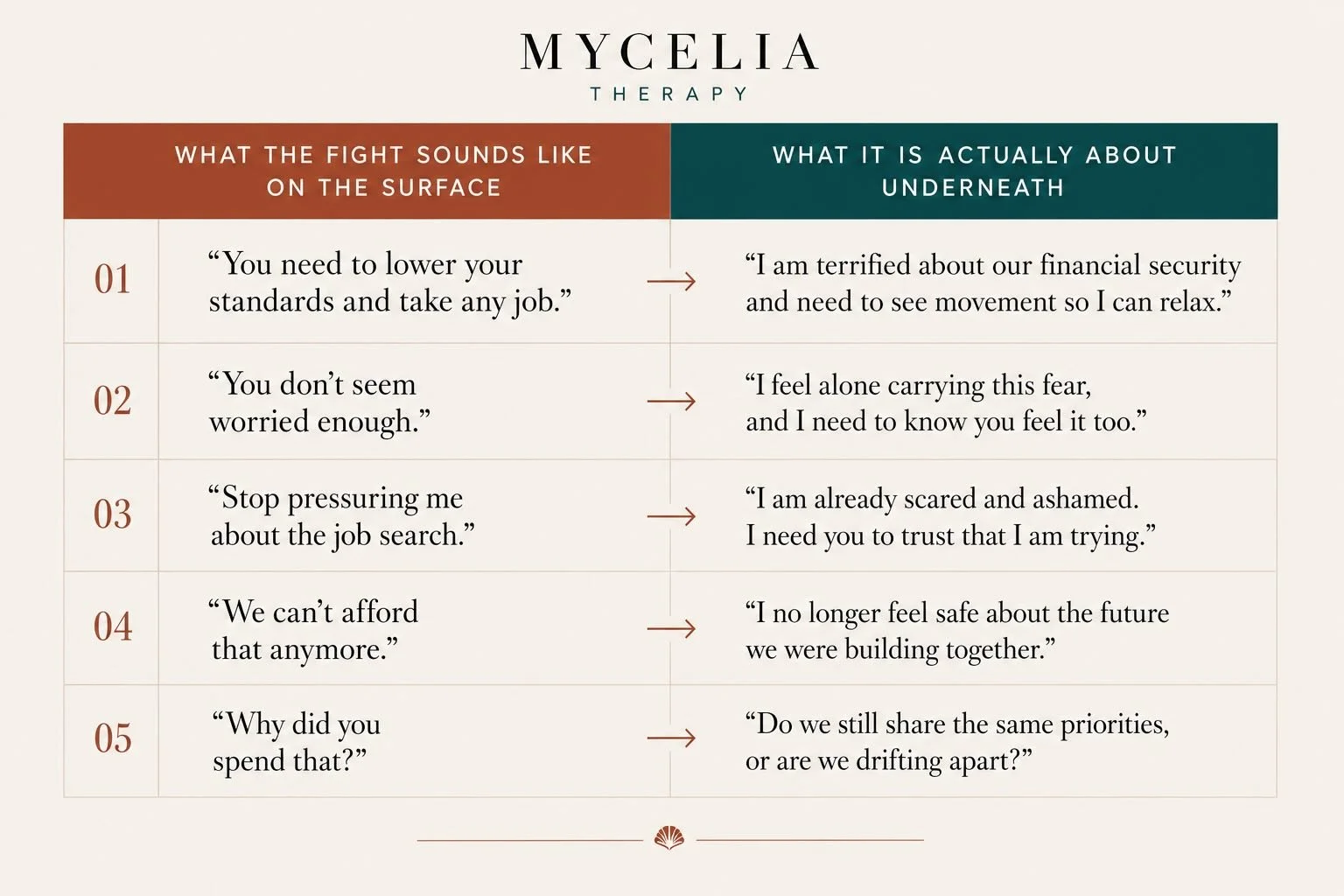
Once you can read your own fights in that right-hand column, the argument stops being a standoff about behavior and starts being a conversation about fear.

Does losing a job threaten your finances or your identity?
In my experience, job loss threatens identity more than finances. Especially for high achievers, the career and the self grew up together. The title was not just a job. It was the answer to "who am I and what am I worth?"
When these clients lose a job, they do not just lose a paycheck. They lose structure. They lose community. They lose status. They lose the feeling of contributing. They lose a future they had already counted on. Even with months of severance in the bank, the panic can be just as loud, because the threat was never only financial.
This is not only my clinical impression. Work supplies structure, identity, and purpose, and research summarized by the American Psychological Association finds that people who lose jobs report lower satisfaction with their lives, marriages, and families, not only lower income.
This is why two partners with the same bank balance can experience the same layoff completely differently. One sees a budgeting problem with a clear timeline. The other is in mourning and cannot find the words for it.
“Their partner thinks the worry is about the family’s money. What the person is actually grieving is the loss of a version of themselves. ”
That gap is where couples miss each other. Both are scared. They are just scared about different things, in different languages, and neither one feels understood by the other. If two careers are colliding in your house, this is also why work-life balance as a couple is less about scheduling and more about what work means to each of you.
Is AI creating a new kind of relationship stress?
Yes. AI is creating a new category of relationship stress, and almost no one is naming it yet. This is the work I am putting my attention on.
AI is changing how people think about careers, expertise, and economic security. For the first time, deeply educated, highly successful professionals are asking whether the exact skills that built their careers will keep them safe. That question does not stay at the office. It comes home.
“ AI is no longer only a workplace issue. It is becoming a relationship issue, because it changes how safe two people feel about the future they are building together.”
It shapes how couples talk about money, children, housing, retirement, and risk. Plenty of couples are now trying to plan a future that feels less predictable than it did even five years ago. Most therapists are not talking about this, and most financial advisors only address the math. I think it will become one of the central pressures in couples work over the next decade. I have written more on the identity side of this in AI overwhelm and the identity crisis it sets off in high performers.
CASE STUDY
A Silicon Valley couple who could not stop fighting about a job search
The problem. I worked with a couple in their early 40s, together 11 years, both senior in tech. One was a product director, the other in engineering leadership. One of them was laid off. At first it looked manageable. The severance was generous. Six months of pay, healthcare covered, real savings underneath.
The partner who lost the job was even relieved. The role had become unsustainable.
The trouble came later. Nine months in, still no offer. The market was far tighter than anyone expected. Applications went out and nothing came back. They carried a mortgage and some debt. The still-employed partner started watching their own company shed departments every few weeks and move work to outsourced teams. "I could be next" stopped being a thought and became a forecast.
The conversations turned into this. "You need to lower your standards and take anything." "You don't seem worried enough." "What if I get laid off too?" On the surface, a disagreement about job-search strategy.
They came to me because, supposedly, one of them "was not looking for work properly." The pursuit. I do not treat a couple as if they live in a vacuum.

So the first thing we did was take pressure off the system, not the relationship. I referred them to a financial advisor to map their actual runway, because the panic was running on a worst-case story, not a real number.
Then we translated what each person was really saying. The employed partner was saying, "I am terrified. I need to see you moving so I can relax." The laid-off partner was saying, "I am already scared and ashamed. I need you to trust that I am trying." Neither had said those sentences out loud. They had said "take any job" and "stop pressuring me" instead.
The payoff. Once the runway was clear and the fear was named, the fight changed. They stopped auditing each other and started facing the actual problem together, which was a brutal market and a real possibility of a second income loss. The uncertainty did not disappear. But it stopped living between them and started sitting in front of them, where they could both look at it.
That is the shift I look for. You can see more of how this works in couples therapy for conflict resolution. If you recognized your own marriage in that story, you are the couple I work with. I see a limited number of California-based couples each month, in person in San Francisco and virtually across the state. You can book a free 20-minute consultation to talk through what is happening between you.
Why do most therapists miss the real reason couples fight?
Many therapists over-psychologize practical problems. They treat people as if they exist outside of any economy, with no industry, no incentives, no labor market reshaping the ground under them.
“I do not see a couple in isolation. I see them inside an ecosystem. ”
That comes from the work I did before this one. Fifteen years advising Fortune 500 clients, founders, and leaders taught me how systems behave: how incentives work, how labor markets move, how disruption actually lands.
So when a couple is in financial stress, I do not assume the problem is psychological by default.
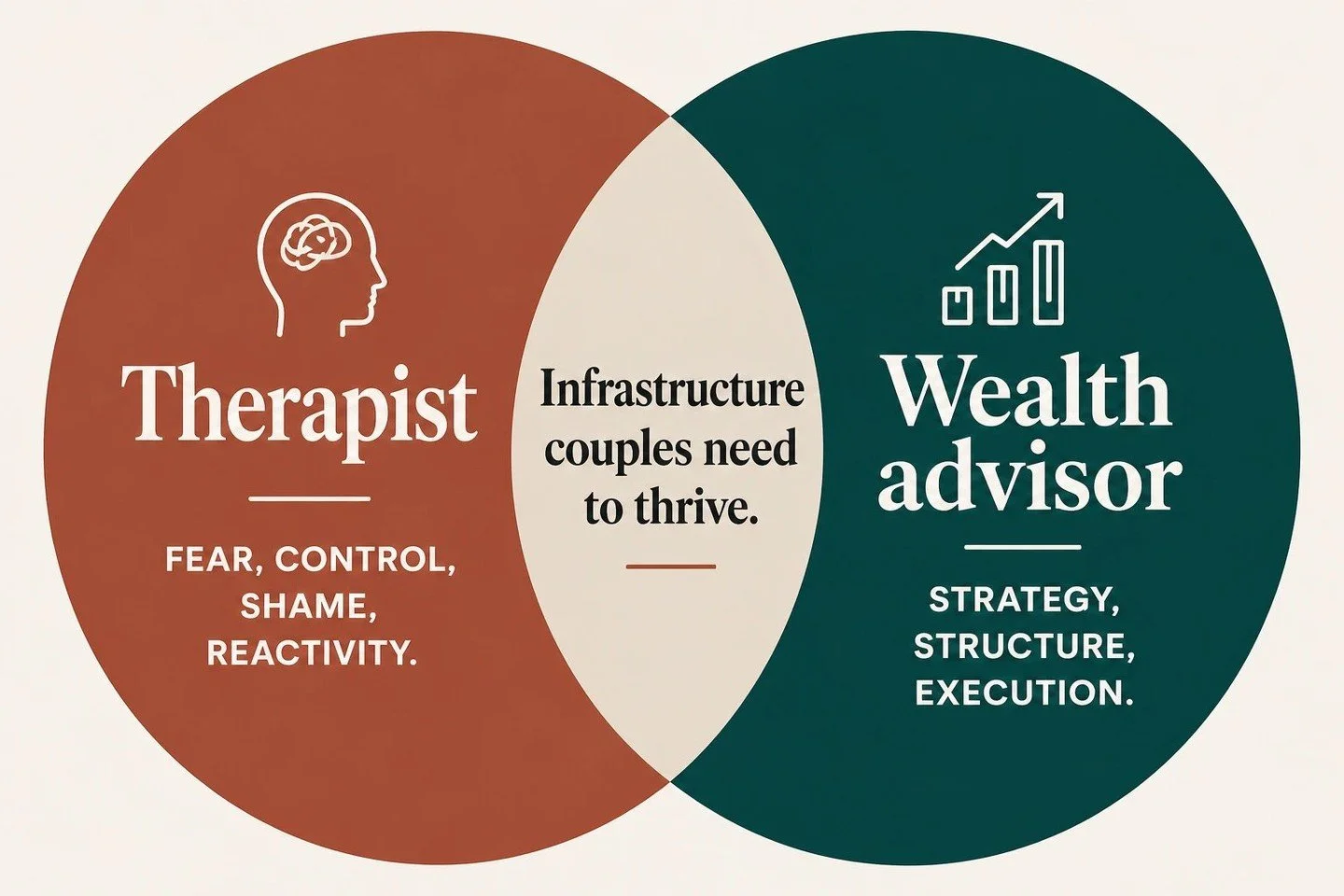
“Sometimes the most useful thing I do is refer out, to a financial advisor or a tax planner. Reduce the pressure on the system and you reduce the pressure on the relationship. Some couples genuinely need a plan before they need better communication, and pretending otherwise keeps them stuck.”
This is also why I think the structure of a therapist's own practice matters. A practitioner running their entire caseload through low-paying insurance panels is operating from survival too. It is hard to see a client clearly when you are both inside systems built on scarcity.
The mechanism is the same whether someone earns a modest salary or millions. I would rather see the whole system than pretend the couple lives outside it. This is the kind of pressure I work with most in therapy for entrepreneurs and executives.
What changes when couples stop fighting about money?
The biggest change is simple. They stop seeing each other as the problem and start seeing uncertainty as the problem.
“The partner stops being irresponsible, controlling, lazy, anxious, demanding, or unrealistic. Both people recognize they are responding to the same threat in two different ways.”
They also stop treating job loss as a personal failure and start treating it as a systemic challenge. The question moves from "what is wrong with my partner?" to "how do we face this together?"
Once a couple can stand on the same side of the problem instead of on opposite sides of each other, everything moves. The uncertainty does not vanish. But the relationship stops being a battleground and becomes a team again. That is the moment I know they are going to be alright.
This is the core work of an intensive couples therapy format, where we can do months of recalibration in a focused window.
How can you stop fighting about money and jobs this week?
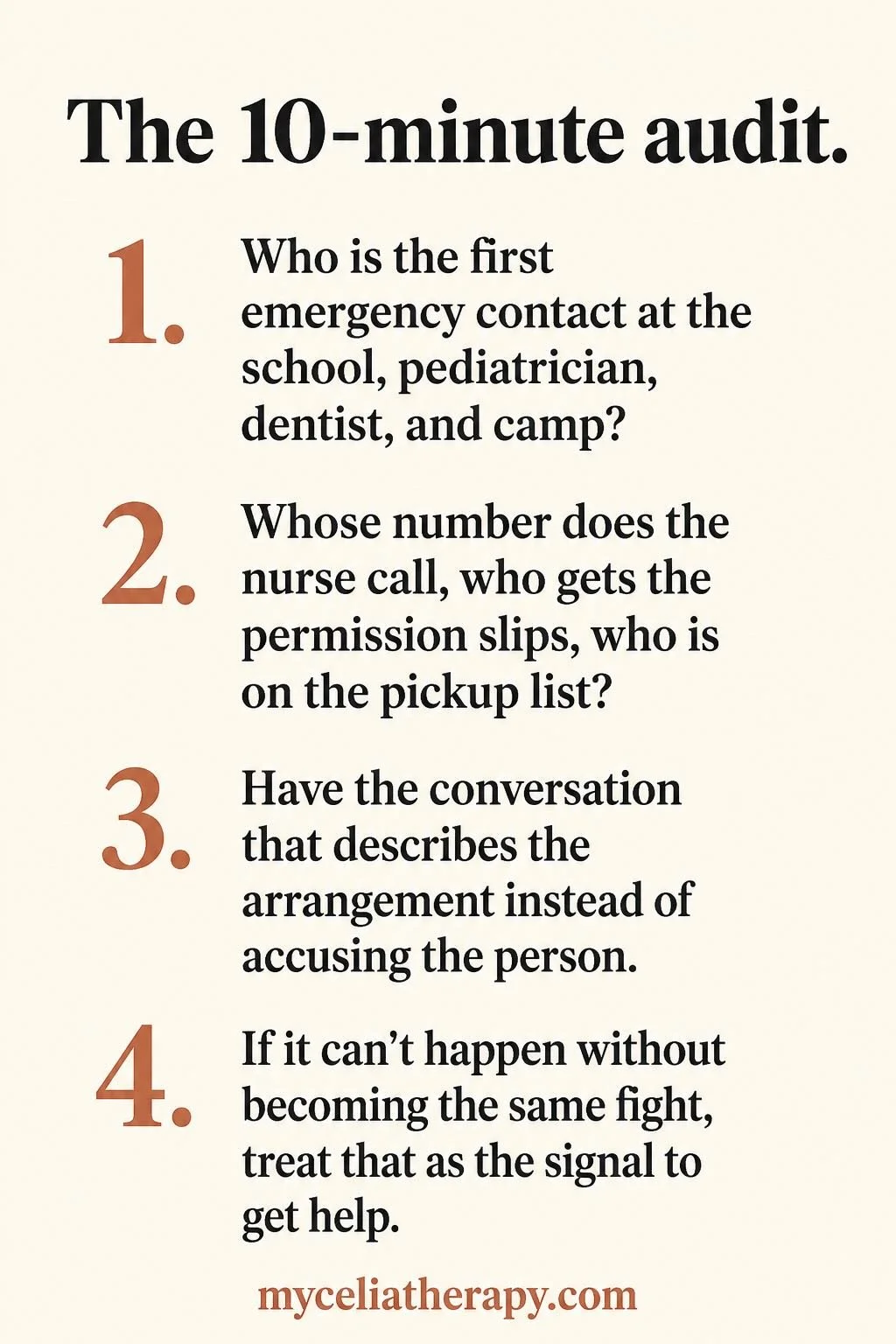
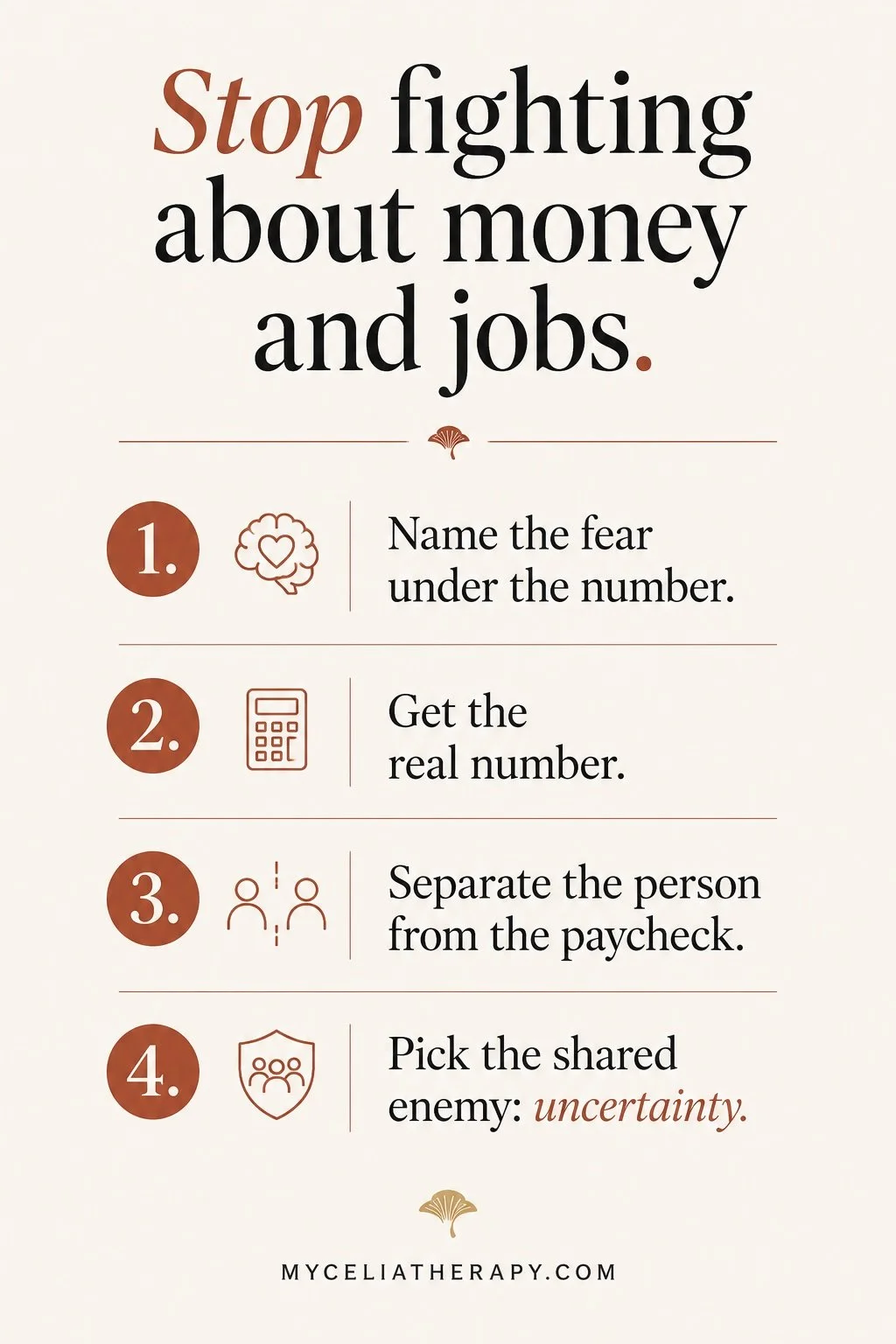
You do not need a perfect plan to stop the fight. You need to move the target off your partner and onto the real threat.
Name the fear under the number. Before the next money conversation, each of you finishes this sentence privately: "When I bring up money, what I am actually afraid of is ___." Then say it out loud to each other first.
Get the real number. Panic runs on worst-case stories. A financial advisor or a clear runway calculation often does more for the fighting than another talk does.
Separate the person from the paycheck. If one of you is out of work, treat it as a market event, not a character verdict.
Pick the shared enemy. Decide, in plain words, that uncertainty is the problem you are both facing, and that you are on the same side of it.
If you are a California-based couple and this is the loop you keep landing in, I keep a limited number of consultation slots open each month. You can book a free 20-minute consultation to see whether this work fits.
Frequently asked questions
-
Stop arguing about the dollars and name what the money represents to each of you. Most couples are responding to fear about security, identity, or the future, not the actual numbers. When you can name the fear and treat uncertainty as the shared problem, the fighting usually drops fast.
-
Because the budget was never the issue. Money is symbolic. If you agree on the math and still fight, you are fighting about what the money means: safety, freedom, status, trust, or whose career counts. The spreadsheet cannot resolve a fear it was never about.
-
Often, yes. For high achievers especially, job loss threatens identity more than finances. People grieve the loss of structure, status, and a future they expected. A partner who only sees the income problem can miss that the other person is mourning a version of themselves.
-
Yes. A layoff raises the threat level for both partners at once, and threat tends to come out as blame. The employed partner often pushes for action while the laid-off partner feels shamed and pressured. Naming both fears directly is what defuses it.
-
Because the surface argument keeps resetting while the real one never gets named. If you fight about the same money or job issue over and over, it usually means a fear underneath it has not been spoken: about security, respect, or whose work counts. Recurring fights stop when you name the fear, not when you re-litigate the budget for the tenth time.
-
It can, but not by ignoring the practical side. Sometimes a couple needs a financial advisor or tax planner before they need better communication. Good couples work reduces pressure on the whole system, then helps the two of you stop fighting each other and start facing the uncertainty as a team.
You are on the same side. Start acting like it. The couples who get through this are not the ones with the biggest severance or the fastest job offer. They are the ones who stop pointing at each other and start pointing at the actual threat together. If you and your spouse are stuck in the money-and-jobs loop, you do not need to white-knuckle it alone. I work with California-based couples, many of them dealing with exactly this: layoffs, career whiplash, and the new pressure AI is putting on careers people thought were safe. Availability is limited, and I take a small number of new couples each month.
About the Author

Giulia P. Davis, LMFT #157653 & Founder Mycelia Therapy
(she/any pronouns)
Giulia P. Davis, LMFT, is the founder of Mycelia Therapy in San Francisco. Before becoming a licensed marriage and family therapist, she spent 15 years in management consulting, advising Fortune 500 clients, founders, and leaders across three continents. She brings that systems-level view into the therapy room, where she works with high-achieving couples and executives on the pressures that careers, money, and ambition put on a relationship. She offers virtual sessions across California, in-person intensives in San Francisco, and couples retreats in Italy.
Her work combines attachment theory, Emotionally Focused Therapy (EFT), Gottman frameworks, Relational Life Therapy (RLT), and Internal Family Systems (IFS). Formats offered: weekly therapy, intensives, and psychedelic-assisted therapy.