Default Parent Burnout: The $500K Cost of Being the One
By Giulia P. Davis, LMFT | Mycelia Therapy | San Francisco, California

Key Takeaways
Default parent burnout is what happens when one partner ends up running the household’s invisible work alone, by default, without anyone ever deciding it should be that way.
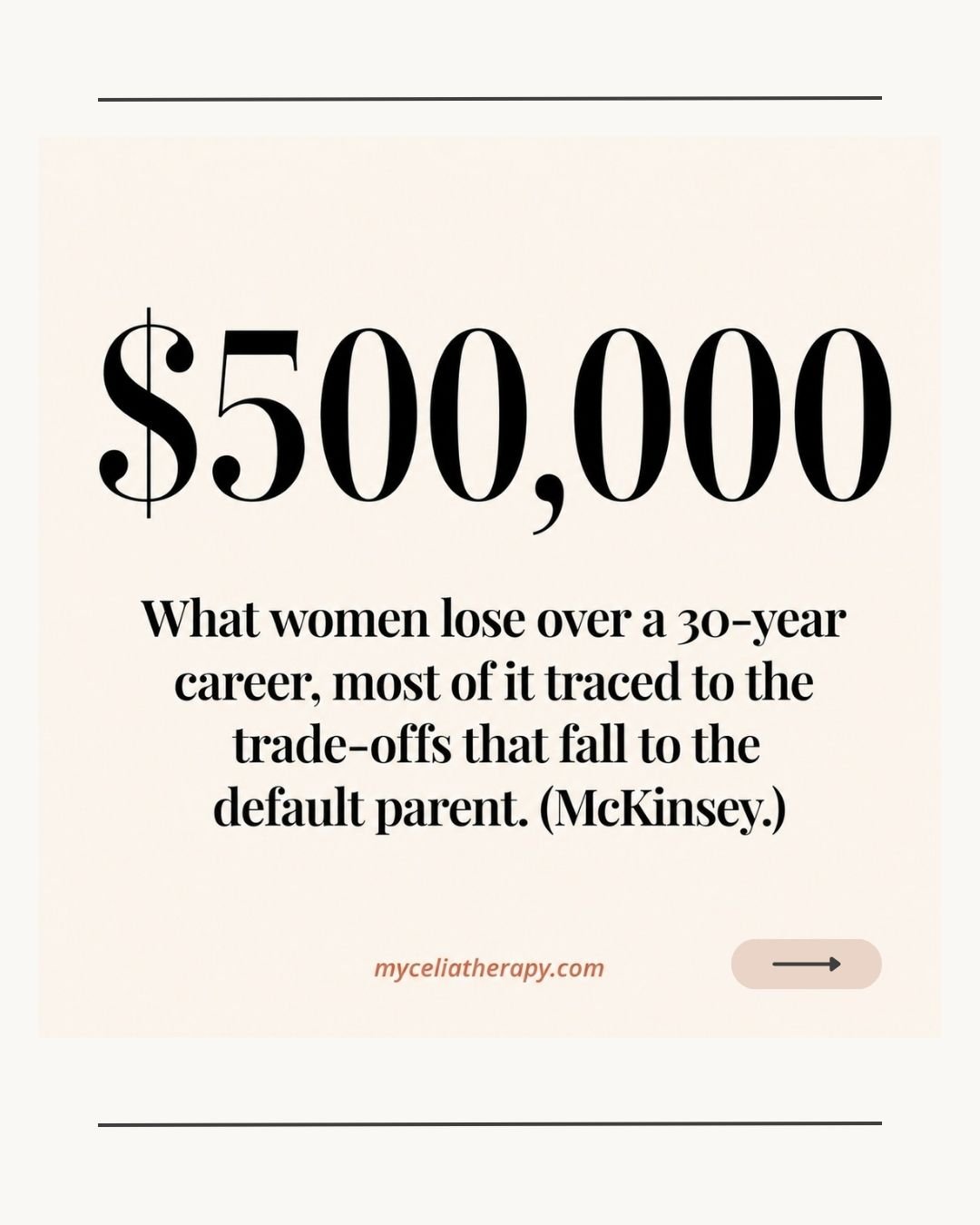
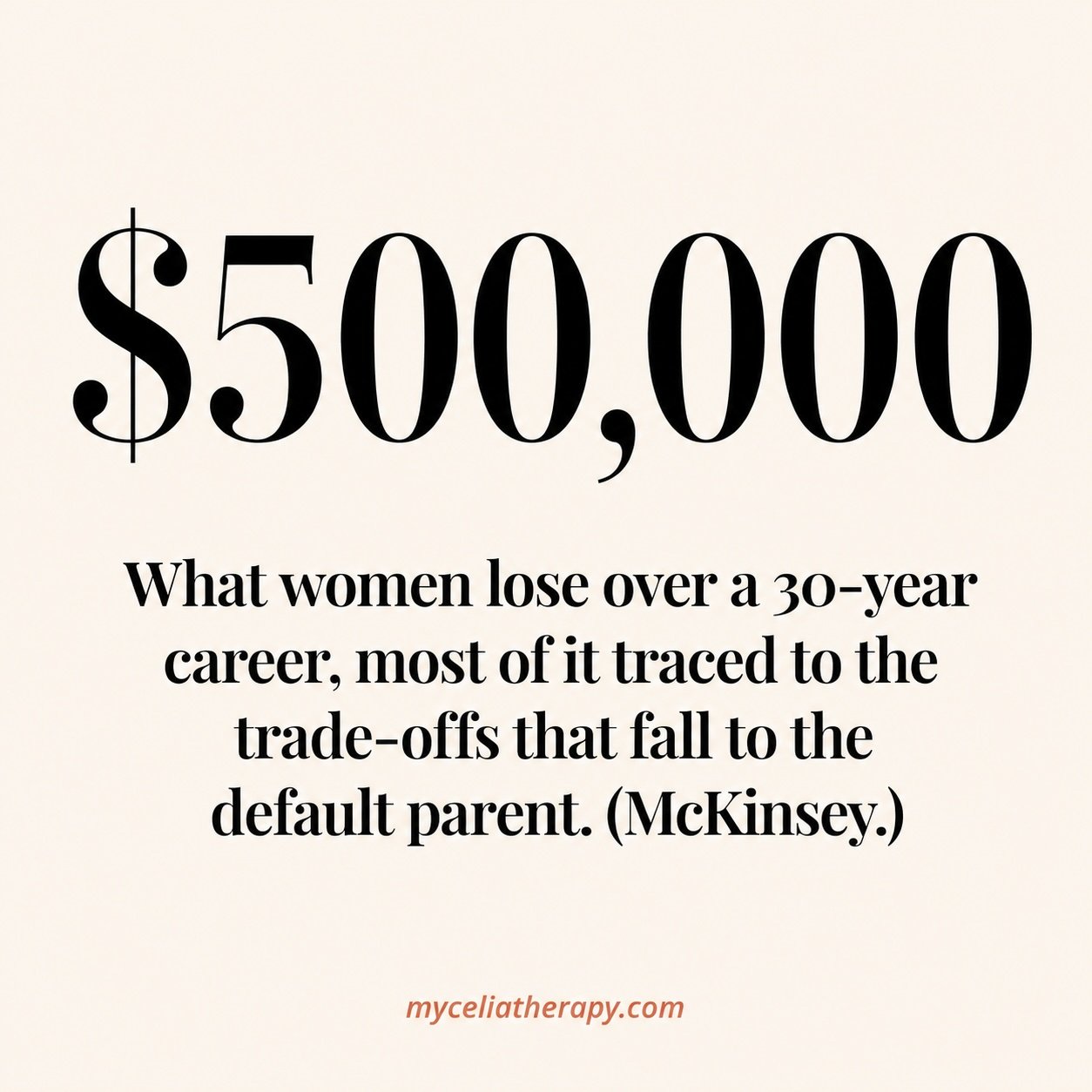
The cost is concrete: about $500,000 in lost lifetime earnings per woman across a 30-year career, per McKinsey. The damage is financial and it lands on her career.
Dividing chores more evenly does not change who owns the work. That ownership is what has to move, and once the pattern has calcified it usually takes structured help.
A woman sat in her car in the office parking garage for twenty minutes one Thursday night before she sent the email. The email told HR she was stepping off the partnership track.
The night before, her husband had looked up from his laptop and said, “I don’t understand why we can’t just hire more help if this is stressing you out so much.” He meant it kindly. Hiring someone would take things off her plate, and the plate was what he could see. What he couldn’t see, the part that becomes default parent burnout, was the carrying: she was the one who always knew what came next and what had already been missed, and no amount of hired help moves that off one person.
The phrase most people reach for is working mom burnout. The exhaustion is real. The harder question is who, by default, ended up running the household, and what that has quietly cost her. Over a 30-year career, women earn about $500,000 less than men, and McKinsey ties roughly 80% of that gap to the time and career trade-offs that fall to whoever is the default parent.
I spent 15 years in management consulting before I trained as a therapist, much of it on M&A due diligence: figuring out what a company that looked fine on paper was quietly losing.
“A company eventually audits what it’s been ignoring. A family usually waits until the person carrying it can’t anymore.”
The two weeks after Mother's Day is one of the busiest inquiry stretch of the year for me. The call comes from someone who spent the holiday producing it: she booked the brunch and reminded the kids to sign the card, then spent the day hoping it would make the rest of the year feel more shared.
What is default parent burnout?
Default parent burnout is the wear that builds in the person a household quietly runs through, the one who carries the parts of family life that have no deadline and no witness. Like noticing the shoes won’t fit before the field trip, or that the dentist appointment everyone forgot is three months overdue. It has little to do with chores. You can split those by Sunday night. The carrying doesn’t move when you do.
Most people who feel this go looking for working mom burnout. It’s the phrase that’s available, and the tiredness is real. A weekend away helps it for about as long as the weekend lasts. Then she comes home to the same job that was never named or shared, and within a week she’s back where she started.
The work is somewhere else: an arrangement nobody chose and nobody has looked at directly. If the cognitive side is what you feel most, I’ve written separately about the mental load in high-achieving couples.
What does default parent burnout actually cost?
Start with the number, because it's the part nobody says out loud: about half a million dollars over a 30-year career. The trade-offs that get her there don't look dramatic in any given year, going part-time, or taking the lateral move that fit the school pickup instead of the promotion that didn't.
It compounds because the early choices set the base everything later grows from. The year she went to four days didn't just cost one year at 80% pay. It lowered the number every raise after that was a percentage of, and the retirement match along with it. A small reduction, repeated for decades, is most of how you get to $500,000.
In plainer terms, that's a child's college paid for, or the difference between a layoff being a problem and a layoff being a crisis. It's what her career absorbs so the household keeps running.
Inside a company, finding the cost no one can see is somebody's job. A family has no one assigned to it, so it runs until the person quietly carrying it stops being able to.

How did you become the default?
Almost no one chooses this. It accumulates, and it usually starts at maternity leave. One parent is home, learning by necessity how the whole thing works: which pediatrician answers email, what the baby's reflux responds to at two in the morning. The other parent goes to the office and stays fluent in a different set of things. By the time leave ends, one of them knows the household and the other knows that the first one knows. From there it's simply easier to ask her, every time, until asking stops happening because the answer is assumed.
Bright Horizons' 2024 Modern Families Index, a UK survey of more than 3,000 working parents, found that 74% of working mothers carry the mental load for parenting, against 48% of working fathers. The pattern is set by fluency, not biology: whoever learned the systems first keeps them, and it hardens because no one goes back to question it.
This shows up in same-sex couples too, where one partner usually becomes the one it runs through, and in single-parent households, with no one to share it. The version with a wife in it gets singled out for a financial reason: it stacks on top of an existing pay gap and turns into the half million. I've written separately about how that plays out as conflict about money.
What does default parent burnout look like in high-performing couples?
In couples where both people are high performers, this rarely arrives as a complaint about chores. It arrives as a career decision that looks voluntary from the outside.
Case Study
The following is a composite, drawn from patterns across many clients over the years. No single person is described. Names, roles, and the details of conversations have been changed or invented to protect confidentiality.
She was on the partnership track, two kids under ten, married to someone whose career was also demanding. Nothing about the marriage looked like it was failing, which is part of why it took so long to name.
The Thursday night was the hinge. She sat in the parking garage for twenty minutes before sending the email stepping off the track. The night before, her husband had said, with no edge in it, "I don't understand why we can't just hire more help if this is stressing you out so much." Hiring someone would have taken tasks off her hands, and tasks were never the heavy part. The weight was being the one who always had to know what came next and what had already slipped.
She came in months later. She wasn't in crisis; she said a version of what I hear often, that she loved her family and was running out of room to exist inside it. When we marked who actually carried each decision in an ordinary week, the picture was lopsided in a way neither of them had seen.
The reframe that landed wasn't flattering. She hadn't stepped back for the children, and she hadn't run out of drive. The arrangement at home couldn't hold two careers at full size, and it had been making room by shrinking hers, a little at a time, for years. The resignation was just the first time the cost showed up somewhere she could see it.
Why doesn't better communication fix it?
Most couples try to fix this by communicating better, and it mostly doesn't work, which is confusing because communicating better is good advice for almost everything else.
A shared calendar, a chore app, a Sunday planning call: these move tasks around. They don't move the job of knowing what should be on the calendar in the first place. That job stays with the same person, now with better tooling. Research in the Journal of Pediatric Health Care found that 65% of working parents report burnout, concentrated in the ones holding that job alone.
It's why the fights sound like "but I told you." The information got transferred; the responsibility for tracking it stayed in the same head. A fact handed to someone who isn't tracking it tends to fall straight through. The change that matters is in who's responsible for knowing the work exists, not who completes it when handed it. Most couples can't make that change alone, which is the same pattern I describe in what couples are really arguing about when they argue in circles
How do you find out who's actually carrying it?
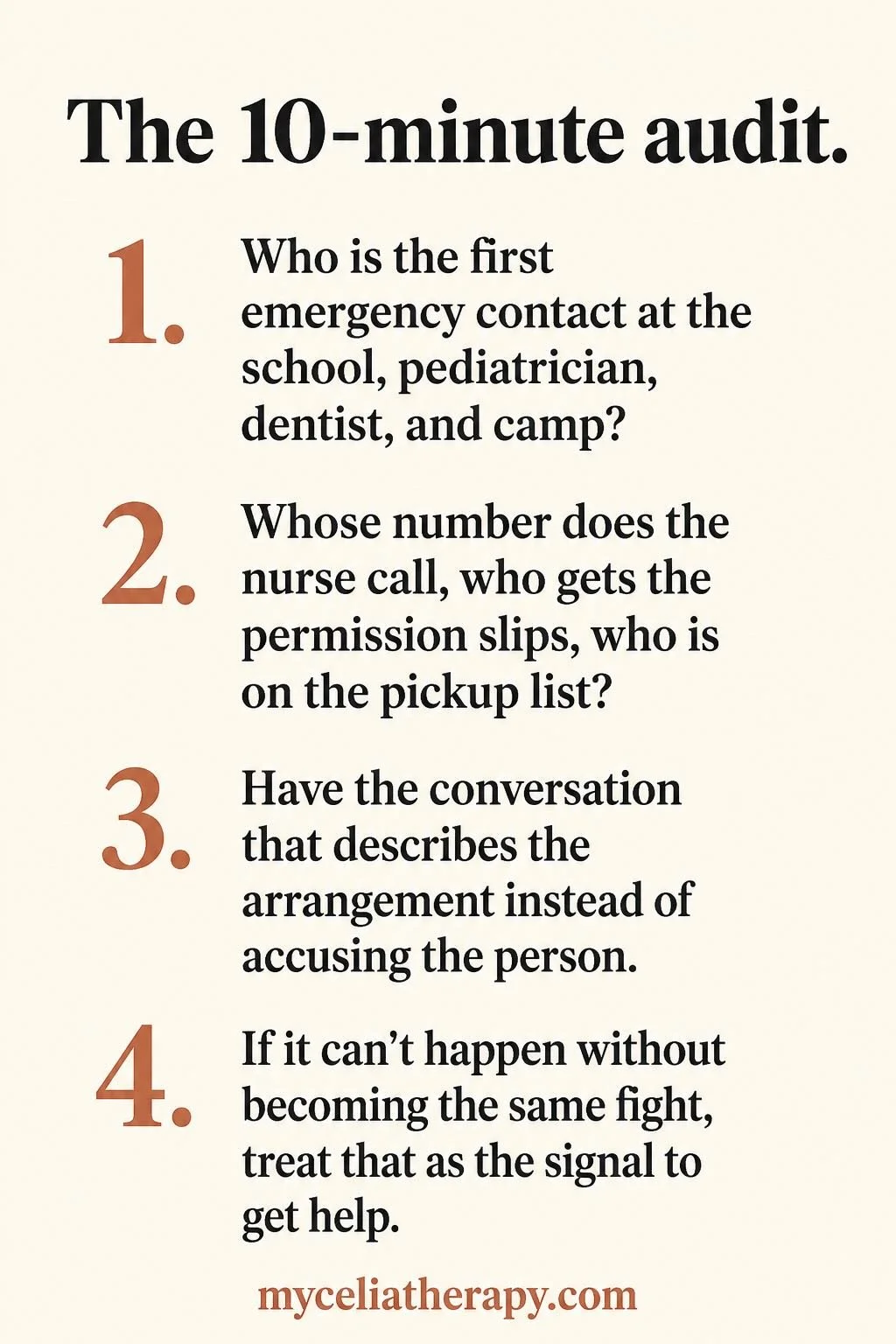
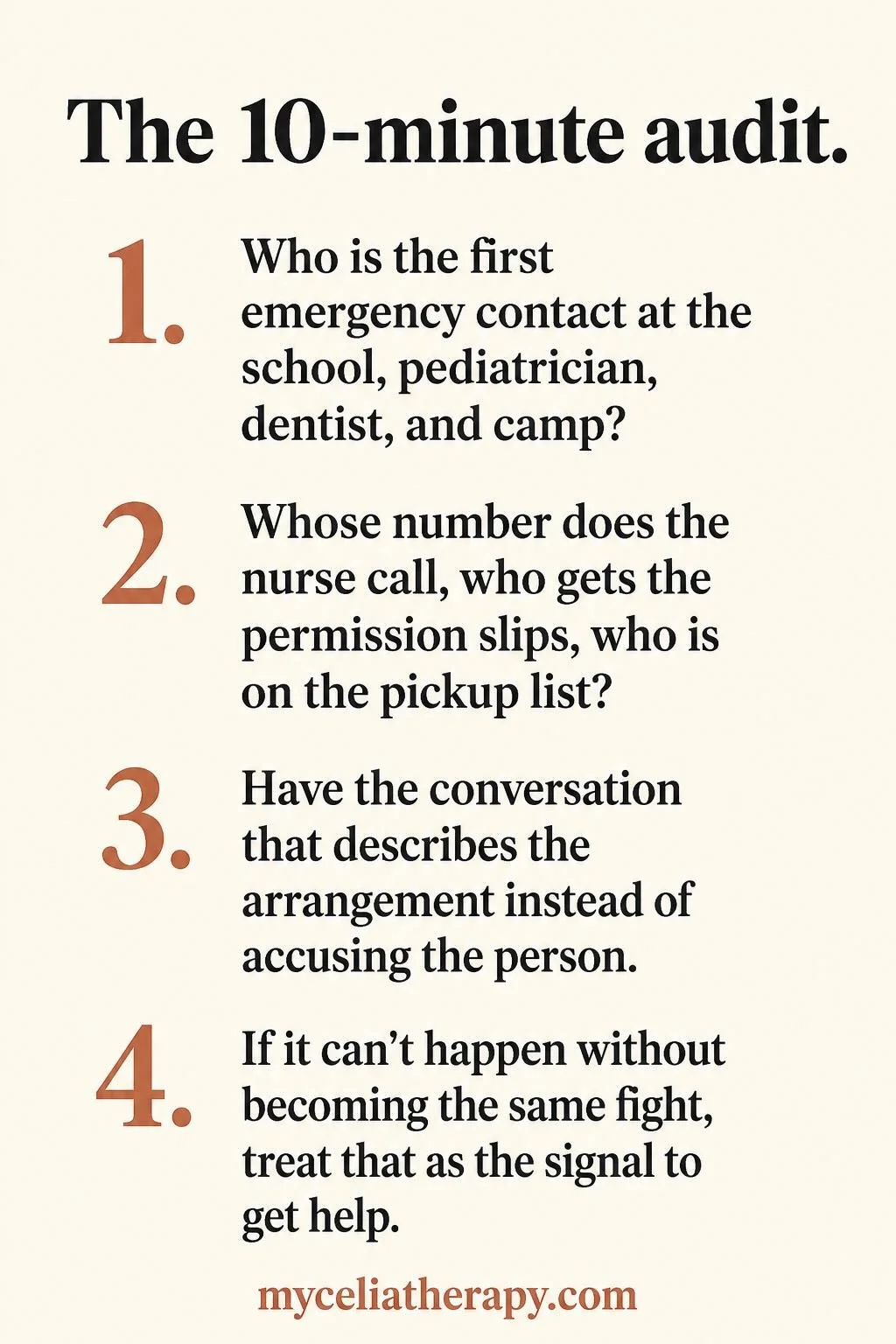
You can find out in about ten minutes, tonight, without your partner in the room.
Open your phone and look at who is the first emergency contact everywhere your kid is enrolled, the school and the pediatrician and the dentist and the camp. Then check whose number the nurse calls, whose inbox the permission slips land in, who is on the pickup list. Most couples have never looked, and most assume it's roughly even. It's usually one person, at almost every institution.
Then have the conversation, which goes better when it describes the arrangement than accuses the person. Not "you never help." Closer to: "I think we've ended up with me running everything that doesn't have a deadline, and I don't think either of us decided that on purpose. I want to actually change who's responsible for what, not just split chores for a week." If that goes somewhere, you may not need anyone else. When it can't happen without becoming the same recurring fight, treat that as information.
When should you stop trying to fix this on your own?
The line is fairly clear: when the conversation about the imbalance has itself become one of the recurring fights, you're past what you can renovate from inside.
I work on this two ways. Individual therapy for the person carrying it, before any joint conversation. The first work is getting a clear enough view of what you've been carrying to say it out loud without apologizing. That's the focus of my individual work with women. Couples intensives when both people are ready to rebuild the arrangement together. An intensive is one to three days of focused work in a row, rather than a weekly fifty-minute hour stretched across a year. The research suggests a few concentrated days can do what roughly six months of weekly sessions would, with gains holding a year and two years out. Aftercare is built in. Read about how couples intensives work and review the couples intensive format.
Fifteen years in management consulting, much of it M&A due diligence, gave me the diagnostic muscle for this work: finding where something is quietly going wrong somewhere no one is looking. The household version is the same diagnosis, with the added difficulty that the people involved love each other.
If this is landing and you're in California, you can book a free 20-minute consultation. I take a small number of new executive women and dual-income couples each quarter, deliberately, so the work stays deep.
Frequently Asked Questions
-
Check who is listed as the first emergency contact wherever your child is enrolled, school, pediatrician, dentist, camp, and who actually gets the call when something goes wrong. If it's the same person almost everywhere, that person is the default parent. It usually maps onto whoever carries the planning and remembering for the family, which in Bright Horizons' 2024 UK Modern Families Index was 74% of working mothers, against 48% of working fathers.
-
Working fewer hours or communicating better doesn't move it, because the load is being responsible for knowing the work exists, not the tasks themselves. What moves it is reassigning whole areas, medical, school, logistics, so the other parent owns the knowing. Expect four to eight weeks where things get done differently while the other person learns the systems. If you can't get through that handoff without it becoming the same fight, structured help is the realistic next step.
-
Yes, but not while you're also the sole default parent, because there isn't enough of one person for both. The version that works keeps the career and moves the default role off one set of shoulders, with "present" meaning reliably there and regulated rather than personally doing every task.
-
The regret is usually pointed at the wrong thing. The return to work didn't create the imbalance; an unrenegotiated handoff after leave did, when one parent was set up as the one who knows everything and nobody reset it. The useful move is changing who's responsible at home, not leaving the job.
-
They overlap without being identical. The mental load describes the work itself, the planning, tracking, and remembering. Default parent burnout describes what carrying all of it does to the specific person doing it.
-
In heterosexual couples it's overwhelmingly the woman, not for any biological reason but because the arrangement tends to set during maternity leave and never gets revisited. It happens in same-sex couples too, and single parents carry it with no one to share it with. The version with a wife in it gets singled out because it stacks on top of an existing pay gap and, over a career, adds up to about $500,000 in lost earnings
Closing
This is an arrangement that got made by default and never looked at again. It has a real price: about half a million dollars, and a version of yourself you've kept putting off. You can work as hard as you want and love them as much as you do; the arrangement won't move on its own. It moves when someone sets out to change it. The audit takes ten minutes. The conversation takes an afternoon. What needs outside help comes after, when something has to change and the old pattern keeps snapping back.
If you're in California and this is your week, a free 20-minute consultation is the place to start. I keep the number of new clients small on purpose.
Also read: How to Stop Fighting With Your Spouse About Money and Jobs

Giulia P. Davis, LMFT #157653 & Founder Mycelia Therapy
(she/any pronouns)
About the author. Giulia P. Davis, LMFT, is a couples therapist and the founder of Mycelia Therapy in San Francisco. She works with executive women and dual-income couples through intensive couples therapy, individual work, and structured retreats. She spent 15 years in management consulting for Fortune 500 clients across three continents, including M&A due diligence work, before training as a therapist.
She is California-licensed and offers virtual sessions throughout the state, plus in-person intensives in San Francisco and retreats in Italy.