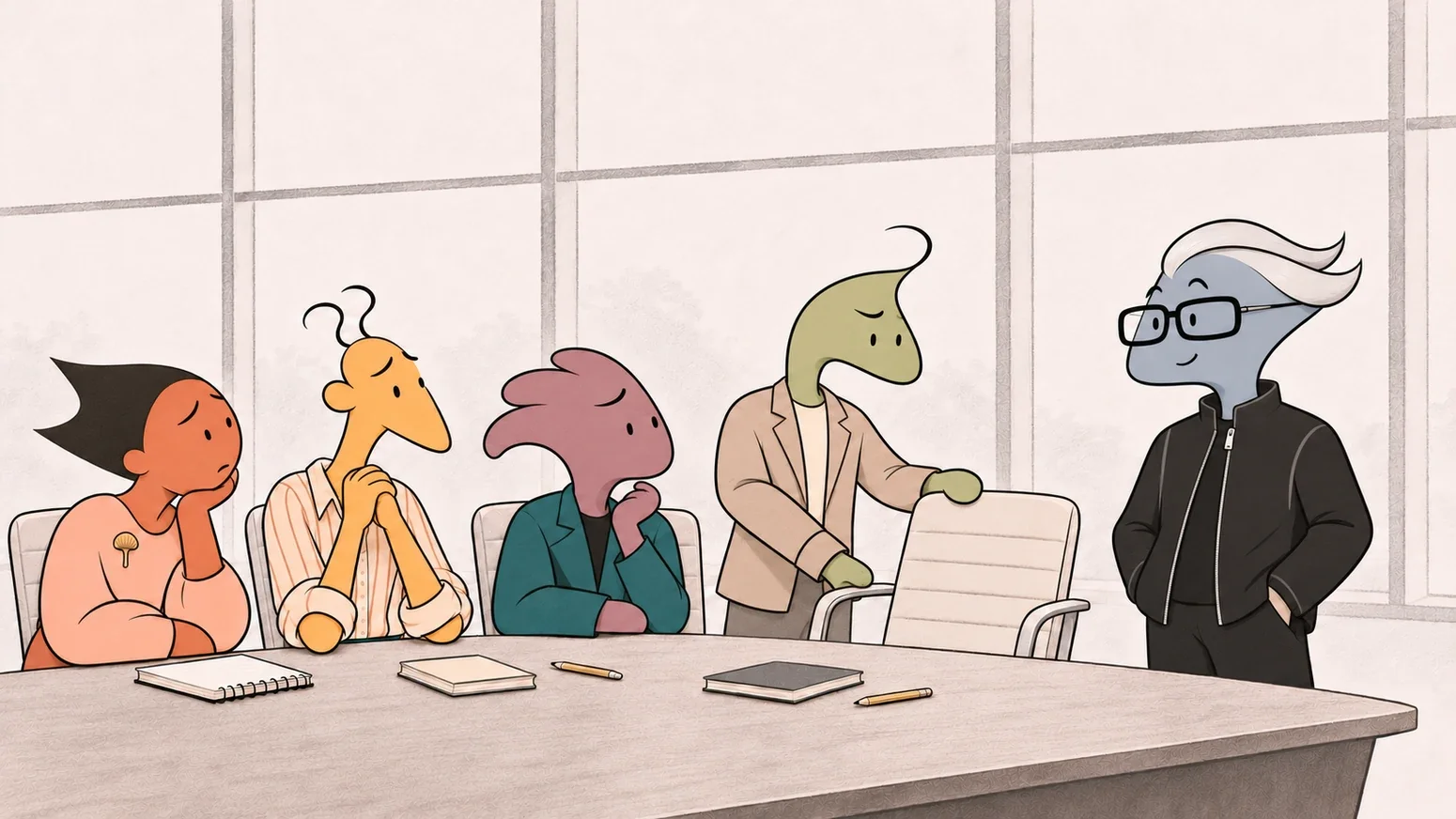
On 18 November, Nvidia’s chair, Harvey Jones, told employees the board had accepted Jensen Huang’s resignation partly over “a lack of candor inconsistent with the company’s code of conduct,” according to WIRED’s reporting on the meeting. Five days later, Nvidia announced that the board had voted unanimously to reinstate him, saying it was “satisfied with respect to Mr. Huang’s candor and ability to lead NVIDIA.” The company said its independent investigation would continue.
The Wall Street Journal reported that before the vote, Huang told the board about additional affairs.
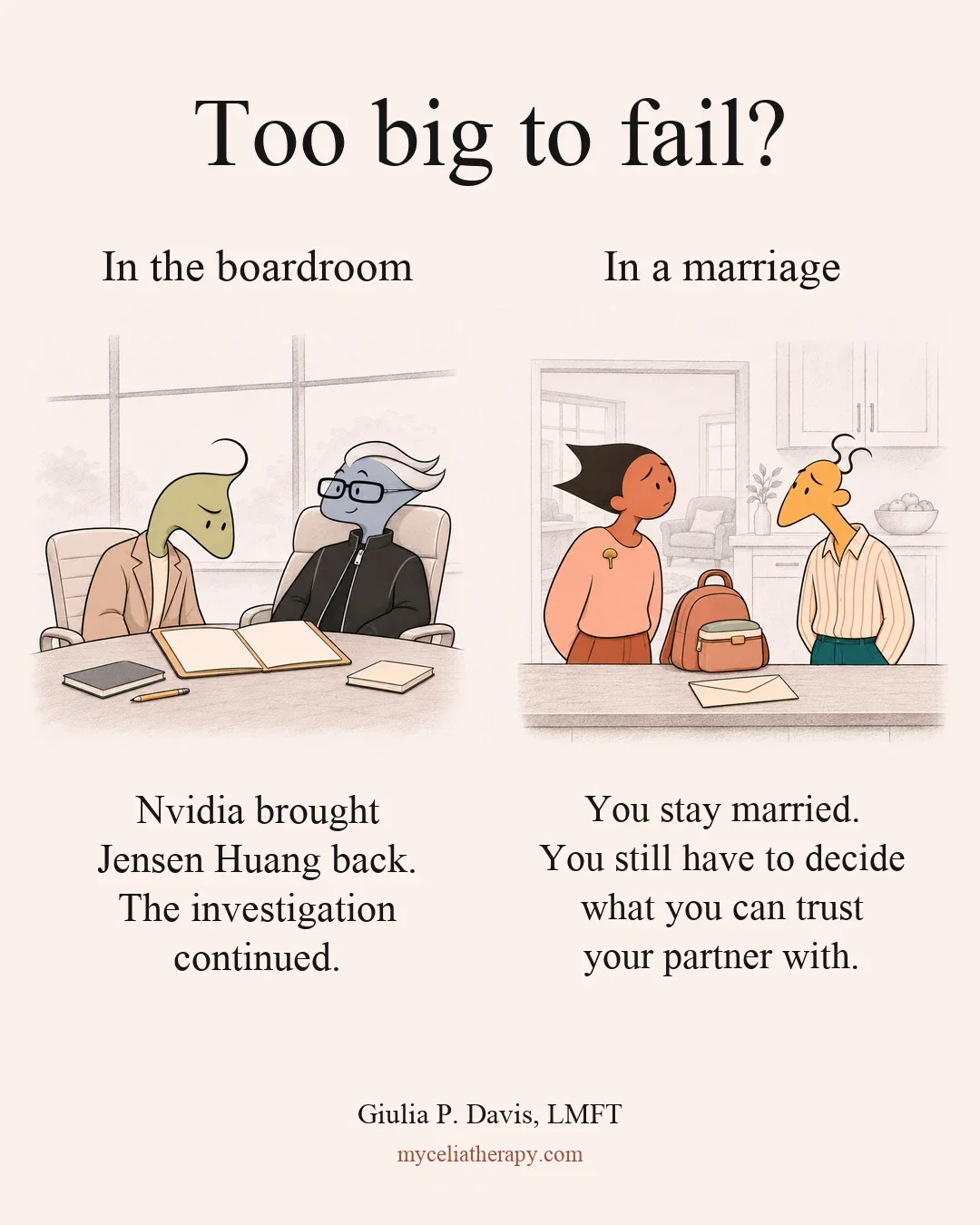
Before I became a couples therapist, I spent 15 years in management consulting for Fortune 500 clients. When someone you depend on lets you down, you may have good reasons to keep working with them. You still have to decide what to trust them with.
Key Takeaways
A marriage can feel too big to fail when leaving would change where you live or how you raise your children.
If only one person can ship a product, keeping them on may buy you time to train someone else.
What someone does after an apology can help you decide what to share or delegate again.
What does “too big to fail” look like at work?
In finance, “too big to fail” describes an institution whose collapse could do damage well beyond the institution itself. Inside a company, there’s a smaller version of that calculation when too much of the work depends on one person.
Say your co-founder misled the board about a hire. They’re also the only one who can ship Friday’s release. Now a decision about how to respond to the hiring issue is also a decision about whether the release goes out. You might keep them in the job while you review how the hiring decision was made and who else can take over a release.
When does a marriage feel too big to fail?
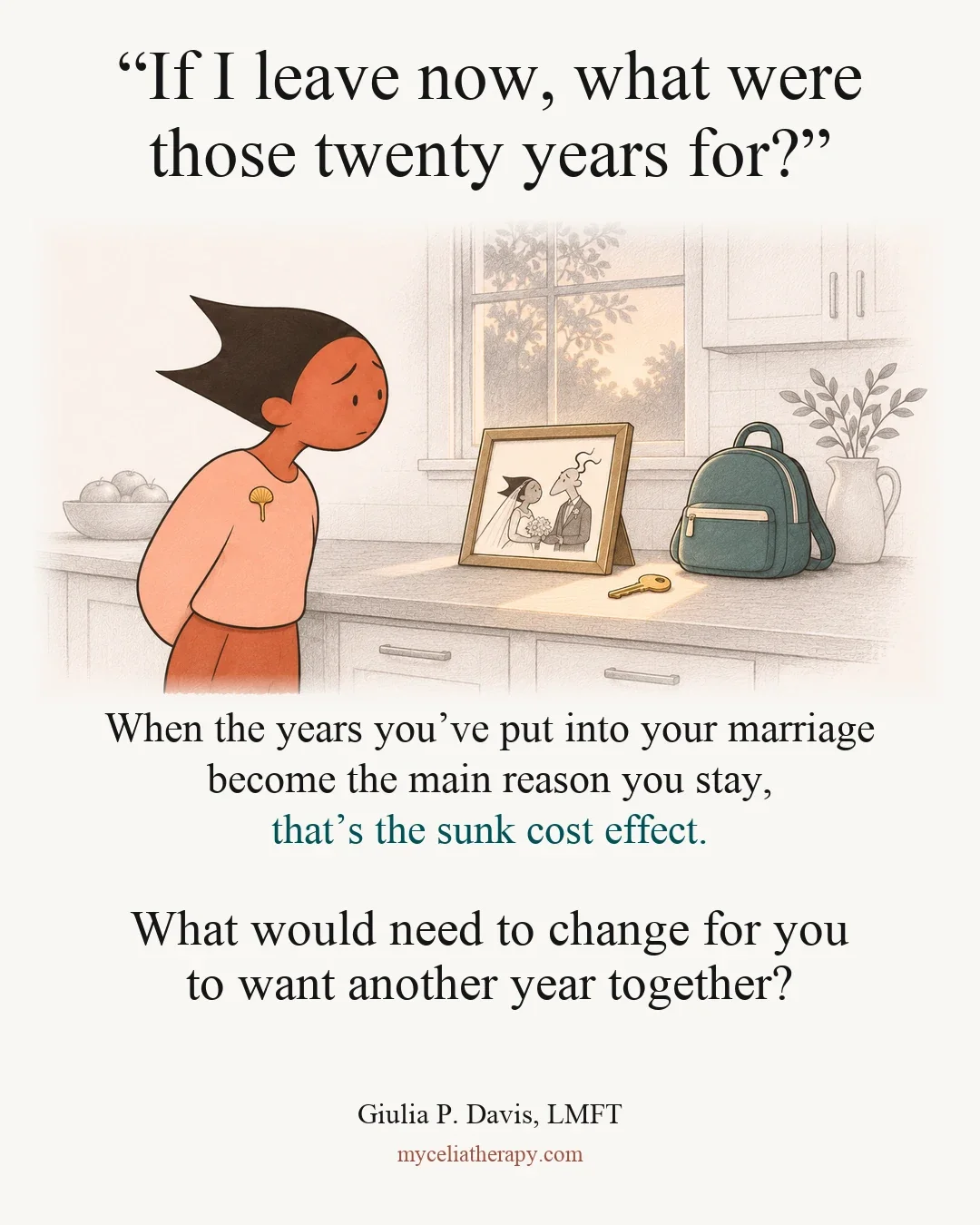
If you share a mortgage and one of you does school pickup every day, deciding whether to stay involves where you’ll live and how the kids will get home. Caryl Rusbult and colleagues describe the investments that tie people to a relationship. Some are things you put in over time. Others are things you built together that you’d have to figure out how to divide or reorganize.
The time you’ve already put in can weigh on the decision, too. One thought to listen for is “If I leave now, what were those twenty years for?” Researchers call the pull to keep going because of what you’ve already spent the sunk cost effect. If you’re deciding whether to stay, ask what you’d need to see change to want another year together.
How does depending on someone shape forgiveness?
Participants in Burnette and colleagues’ 2012 study of forgiveness reported the most forgiveness when they valued the relationship and expected a low risk of being hurt again. The study assessed how willing people were to forgive after remembering or imagining an offense.
The researchers worked with 361 undergraduates and a separate sample of 417 adults recruited online. In the second study, their attempt to change how risky the other person seemed was unsuccessful. That limits what we can say about cause and effect. In a relationship you rely on, it helps to pay attention to what you’d lose and what you have seen the person do since they let you down.
What would you need to see before you trusted them again?
Forgiveness can involve letting go of the urge to get even. Trust is a judgment about what someone will do next. You might forgive your partner for hiding an expense and ask them to tell you the next time before you find it on the statement.
Esther Perel describes affair recovery in phases and places rebuilding trust in the final phase. In couples therapy, you can talk through what you would need to see before you trust your partner again and decide what each of you can do. If asking for an answer keeps leading to one of you pressing and the other pulling back, the pursuer-distancer dynamic can help you name what’s happening. My article on repairing after conflict looks at how to return to the conversation.
How should you think about forgiveness at the holiday table?
The parent who hurt you may also be the one who picks up your kids from school. If you’re seeing them at Thanksgiving, decide what you’re willing to discuss at dinner and what can wait.
Since 1970, Indigenous people and their allies have gathered in Plymouth on Thanksgiving for the National Day of Mourning.
Before you go, ask yourself two questions. Would I forgive this person if I didn’t need them? What would I need to see before I trusted them again?
If the person is your partner and you want help having that conversation, here’s how to choose a couples therapist.
FAQ
Can you forgive someone you don’t trust yet?
Yes. You can forgive someone for hiding an expense and still ask to see the joint statement before you agree to another big purchase.
What can I say if someone asks me to forgive them at Thanksgiving dinner?
“I’d rather talk about this one-on-one. Let’s find a time after Thanksgiving.”
What does “too big to fail” mean in a relationship?
It means losing the relationship would upend something you depend on. In a marriage, that could be where you live or who picks up the kids. Those are real costs to weigh alongside what you’d need to see change to want another year together.
Should you forgive a co-founder who lied to you?
You can keep working together while you decide whether to forgive them. If they lied about a hire, agree on who can approve the next one and set a date to revisit that arrangement. At the review, look at what they shared before the decision and what you still had to find out yourself. I help business partners work through decisions like this in co-founder coaching through Mycelia Coaching.
If you’re in California and you’re weighing a decision like this, a free 20-minute consultation is a place to start. I offer therapy for founders and executives and work with couples facing decisions about what it would take to trust again.
About the Author

Giulia P. Davis, LMFT #157653 & Founder Mycelia Therapy
(she/any pronouns)
Available for commentary. Press page
Giulia P. Davis, LMFT is an Italian-born, San Francisco-based Licensed Marriage and Family Therapist and founder of Mycelia Therapy.
Before transitioning to clinical practice, she spent 15 years as a management consultant for Fortune 500 clients, building distributed teams across three continents and eventually founding her own consultancy. She brings that same systems-thinking lens to the work she does with couples, understanding relationships not just as emotional bonds, but as dynamic structures that can be diagnosed, interrupted, and rebuilt.
Giulia specializes in working with high-achieving couples, executives, entrepreneurs, and ENM/polyamorous relationships facing disconnection, recurring conflict, and the particular exhaustion of a life that looks successful from the outside and feels depleted from within. Her intensive and retreat offerings are designed specifically for couples who need accelerated change.
Her work combines attachment theory, Emotionally Focused Therapy (EFT), Gottman frameworks, Relational Life Therapy (RLT), and Internal Family Systems (IFS). Formats offered: weekly therapy, intensives, and psychedelic-assisted therapy.