What Does the Psychotherapy Part of Ketamine-Assisted Psychotherapy Involve?
People researching ketamine-assisted psychotherapy hear a lot about the medicine and very little about the other half of the name. This post covers that half: what I do as the psychotherapist from preparation through integration, and which decisions belong to the independent medical provider.
Key Takeaways
In ketamine-assisted psychotherapy (KAP), the psychotherapist works with you before and after each ketamine session and stays with you by video while the medicine is active.
An independent medical provider decides whether ketamine is appropriate, prescribes it, sets the dose and handles medical follow-up. Those decisions sit outside the therapist’s role.
How much you and the therapist talk during the session depends on the dose and on your own preferences and goals. At lower doses you can have a full conversation with your therapist.
Research has not yet shown how much the psychotherapy adds beyond ketamine alone.
Online KAP adds an adult chaperone at home and a safety plan agreed before every session.

What does “psychotherapy” mean in ketamine-assisted psychotherapy?
It is the therapy that surrounds the ketamine experience, starting before the first dose and continuing after the last. A 2022 systematic narrative review in the Journal of Pain Research of 17 KAP studies concluded that psychotherapy delivered around ketamine sessions can extend and strengthen their benefits, and it found wide variation in how KAP is delivered.
For the overview of the whole pathway, see what high-achievers get wrong about KAP.
What does the therapist do during assessment and preparation?
The therapist assesses whether this is a good time for you to do KAP, and builds enough trust that you already know how we work together when the dosing session arrives.
The medical provider screens for physical and medication risks. My intake covers the psychological side, including how stable things are right now and whether anything in your history makes an altered state harder to be in.
Sessions can be vivid or quiet, and a quiet session still gives us material.
Much of preparation is work on your intentions, in your own words. We might also find a mantra, a short phrase you take into the session with you, and we agree on how I can gently remind you of your intention and mantra while the medicine is active.
We also decide how much you want me to talk and whether you would like a grounding object to hold. You can take off the eyeshade or sit up at any point.
Music is part of most sessions, instrumental and on headphones, and I share a playlist if you want one. Drumming or simple ritual is available only if you ask for it after I’ve described what it involves.
What is the therapist doing during an online dosing session?
It depends on the dose, and on your preferences and goals. At lower doses, sometimes called psycholytic dosing, you can talk and have an active conversation with me. At higher doses there is usually less talking. My attention goes more to your safety, which includes watching how your body is moving, and I take confidential notes on what you say so we can come back to it in integration.
Before the medicine, we confirm where you are and that your chaperone is in the house. The timing and method for taking the medicine come from your prescriber’s instructions, and I cue you when to begin.
Even when there is less talking, some clients still want to be reminded of things, such as their intention or mantra, or that the effects will pass. We can agree on those reminders in preparation.
Video can’t show me everything a person in the room would see, which is one reason the chaperone is there. Your chaperone stays until you are alert and moving around safely.
A dosing session lasts about three hours on average, sometimes up to five, and I generally recommend a course of six to eight dosing sessions.
How does a therapist support you without steering the experience?
By following your lead and holding back on interpretation, because people in altered states are more open to suggestion than usual.
A 2025 scoping review of ethical issues in psychedelic-assisted treatment, published in Psychological Medicine, names suggestibility and undue influence as specific risks and asks therapists to exercise epistemic humility about their own beliefs.
In practice, I ask what something was like and keep my own frameworks, psychological or spiritual, out of the session. You arrive at your own reading afterward, in integration.
What happens if fear, confusion or painful material comes up?
The therapist helps you stay with it safely and leaves the explaining for integration.
First I work out what kind of distress it is. Physical signs, such as chest pain or trouble breathing, go to your chaperone and the emergency plan we agreed, which includes calling 911 for anything severe.
If it’s psychological, what helps depends on you and your history. Sometimes it is hearing where you are and that this will pass. Sometimes it is an invitation to breathe with what’s happening, without needing to figure anything out.
Some approaches frame the response to fear as surrender, which can feel like pressure to someone with a trauma history. I keep real choices available instead. The eyeshade can come off and you can sit up at any point.
What does integration involve beyond talking about the experience?
Integration turns something you noticed in a session into a change in how you act or relate to people.
The first integration session happens within 24 to 72 hours of dosing, and no later than a week. Before then, write down fragments before trying to build a full explanation, because early explanations tend to be tidier than the experience was.
From there, we look for one small, observable change connected to what came up, such as a conversation you’ve been postponing or a meeting where you speak second. Then we track what gets in the way. A flat or unpleasant session still goes into integration, and what surfaced last month shapes the next preparation.

What does the independent prescriber handle, and what does the therapist decide?
The independent medical provider decides whether ketamine is medically appropriate, prescribes it, sets the dose and manages medical follow-up. The psychotherapist does none of those things.
My scope is your psychological readiness and the therapy itself. Once you sign a release of information, the prescriber and I can share notes. I send the prescriber a note after intake, and the prescriber keeps me informed about your dosage.
My presence is part of the protocol, so I can decline to hold a dosing session whenever I don’t feel it is safe or right, including when a client doesn’t want to do integration. If that happens, I tell you directly, and usually it means postponing and adding preparation.
How does doing KAP online change the psychotherapy?
It moves more of the therapist’s work into preparation, because I am on a screen and you are at home.
We plan the room ahead of time: private and comfortable, with a clear route to the bathroom and household noise handled. A chaperone is required. They are an adult who stays in the house, though not necessarily in the room, and I have their phone number in case I need to reach them.
The research on at-home telehealth ketamine is thin. A 2026 systematic review found only three studies, all from US commercial providers, and rated the certainty of the evidence very low. In 2023 the FDA also cautioned that using compounded ketamine without monitoring by a health care provider may put patients at risk. A chaperone and a therapist on video are a different level of monitoring from a clinic, and worth weighing when you choose a format.
If you live in California and want to talk through whether an at-home format suits you, the free 20-minute consultation is the place to start. KAP availability is limited.
How Is Ketamine-Assisted Psychotherapy Different From Ketamine Infusion Treatment?
The main difference is who is involved and when. In infusion treatment, a medical team gives ketamine intravenously in a clinic and monitors you there, and any psychotherapy usually happens separately. In KAP, a psychotherapist is built into the structure, with sessions before and after each dose and presence during it.
Infusion clinics offer in-person medical monitoring that an at-home session can’t. There is a shorter comparison in the FAQ of my earlier post on KAP.
What does the research say about the psychotherapy part of KAP?
Less than most KAP marketing suggests. Reviews of ketamine combined with therapy are broadly positive, and very few studies compare ketamine with therapy against ketamine without it.
A 2023 systematic review in BJPsych Open covered 19 studies and 1,006 patients and found largely positive results. It identified only one study that directly compared ketamine plus therapy with ketamine plus usual care, and that small trial had mixed results. A 2025 observational study (Moore et al.) found no added benefit from psychotherapy for depression or PTSD. In a 2022 trial in alcohol use disorder (Grabski et al.), ketamine beat placebo and the ketamine plus therapy group did best, but its difference from ketamine plus alcohol education was not statistically significant. The authors call the benefit of adding therapy possible.
The reasons I prefer a therapist-integrated model are practical. Someone who knows you is present while you are in an altered state, and what comes up has somewhere to go afterward. Nobody has proven yet that adding therapy makes ketamine work better.
What should you ask when evaluating a KAP provider?
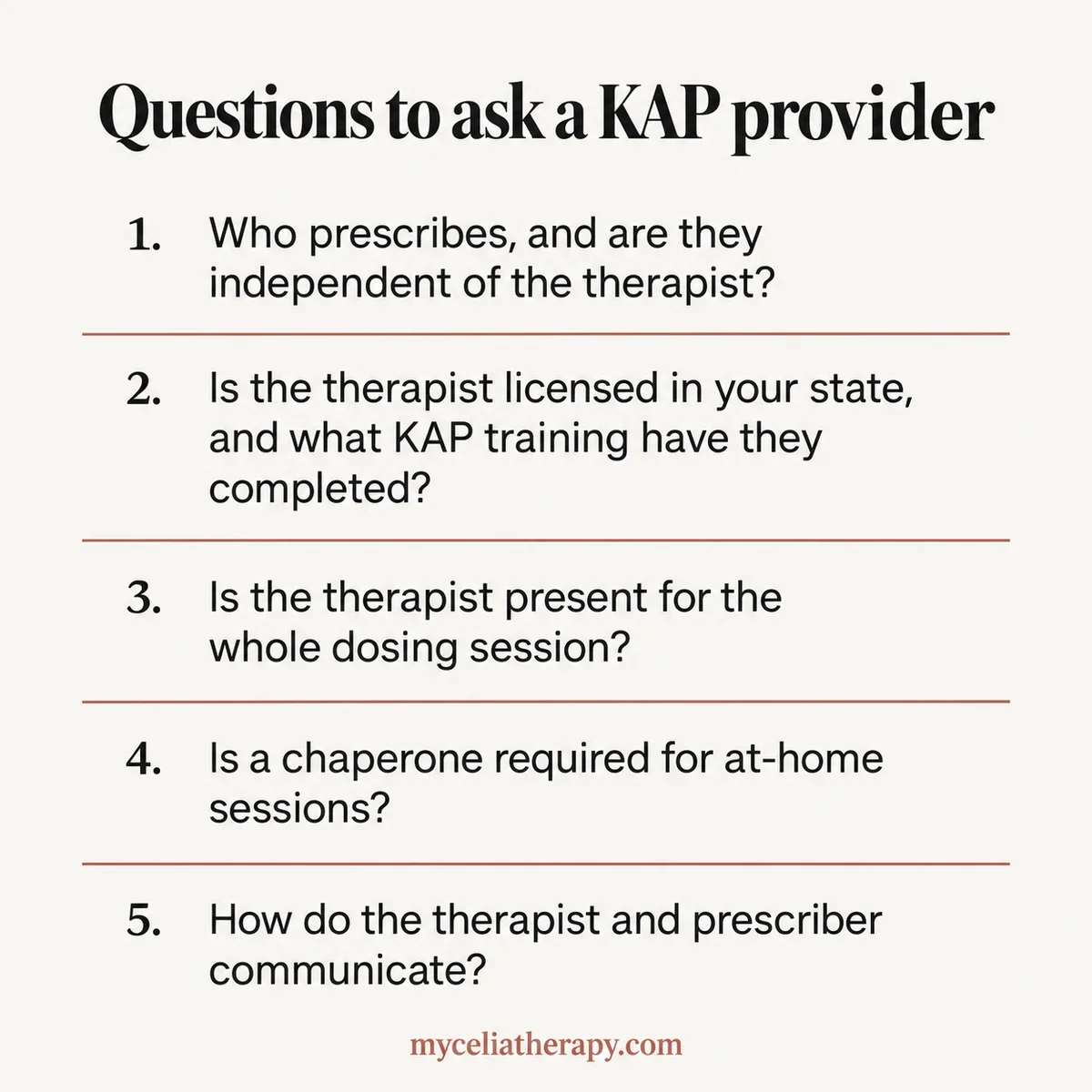
A few questions sort providers quickly. You might ask:
Who prescribes, and are they independent of the therapist?
Is the therapist licensed in your state, and what KAP training have they completed?
Is the therapist present for the whole dosing session?
Is a chaperone required for at-home sessions?
How do the therapist and prescriber communicate?
Is Mycelia Therapy’s online KAP a fit for you?
Mycelia Therapy offers online KAP in California to individuals and to pairs, whether couples or co-founders. I provide the psychotherapy, and an independent medical provider handles everything medical. I completed Alchemy Community Therapy Center’s Ketamine Assisted Therapy Training for Providers. Fees and session details are on the ketamine-assisted psychotherapy page, and there is more about my background.
Many people who ask about KAP have been in weekly therapy for a while, often for burnout that rest hasn’t fixed. Couples weighing formats may find my post on whether a couples intensive is worth it useful.
Case Study (composite; identifying details changed)
When the fear was familiar
A founder in his early fifties came to KAP after two years of weekly therapy elsewhere. He knew he took over whenever his team stalled. In preparation we turned “stop micromanaging” into his own sentence: “I want to see what happens when I don’t hold everything.” He wanted to stay mostly inward during the session, so we agreed I would speak only if he asked.
About thirty minutes in, he said he felt like he was falling. I told him where he was and how long ago he had taken the medicine, and he held the stone he had chosen as his grounding object until it passed.
Two days later he described the fear as familiar, the feeling in a board meeting when a number slips and nobody speaks. We picked one change: in his next two staff meetings, wait for someone else to propose a fix first. He managed it once, and the discomfort became the focus of his next preparation.
Frequently asked questions
Does the therapist give me the ketamine?
No. Your independent prescriber prescribes it and sets the instructions. You take it yourself at home, and I cue the timing according to those instructions.
Can I do KAP if I already have a therapist?
Yes. With your written permission, I coordinate with your therapist so everyone caring for you is on the same page.
What happens if the video connection drops?
We plan for it in preparation. We test the video on the device you will use, and your chaperone and I swap phone numbers. If the connection is unreliable before you take the medicine, we reschedule. If video drops after you have dosed, I call your chaperone and we continue by voice on speaker. If I can’t reach either of you, I call your emergency contact, and if I am still concerned, I call 911 to the address you confirmed at the start of the session.
Where are my session notes kept?
In my HIPAA-compliant electronic health record. I share information with your prescriber only when necessary, and only after you sign a release of information.
How does KAP work for couples and co-founders?
Each of you has your own prescriber screening and your own intake with me. Preparation and integration happen together, and dosing usually happens one partner at a time. If both partners dose in the same session, a third adult needs to be in the home as chaperone, and I consider it only after you have each had solo sessions and your prescriber agrees.
The questions above will tell you a lot about any provider, including me. I work throughout California by secure telehealth, and KAP availability is limited. The free 20-minute consultation is a conversation about whether this format fits you.
This article is educational and is not a substitute for professional help or medical advice. If you are in crisis, call or text 988 to reach the 988 Suicide and Crisis Lifeline.
About the Author

Giulia P. Davis, LMFT #157653 & Founder Mycelia Therapy
(she/any pronouns)
Giulia P. Davis, LMFT is an Italian-born, San Francisco-based Licensed Marriage and Family Therapist and founder of Mycelia Therapy.
Before transitioning to clinical practice, she spent 15 years as a management consultant for Fortune 500 clients, building distributed teams across three continents and eventually founding her own consultancy. She brings that same systems-thinking lens to the work she does with couples, understanding relationships not just as emotional bonds, but as dynamic structures that can be diagnosed, interrupted, and rebuilt.
Giulia specializes in working with high-achieving couples, executives, entrepreneurs, and ENM/polyamorous relationships facing disconnection, recurring conflict, and the particular exhaustion of a life that looks successful from the outside and feels depleted from within. Her intensive and retreat offerings are designed specifically for couples who need accelerated change.
Her work combines attachment theory, Emotionally Focused Therapy (EFT), Gottman frameworks, Relational Life Therapy (RLT), and Internal Family Systems (IFS). Formats offered: weekly therapy, intensives, and psychedelic-assisted therapy.