On Tuesday, one of you is on the 6 a.m. flight to Chicago, and the other has a board prep call that runs past nine. Thursday is the only night you’re both home, and at 10:30 one of you reaches across the bed while the other is already going over tomorrow’s first meeting. “Not tonight.” “Fine.” Nobody mentions it on Friday.
When a couple has mismatched sex drives, the most useful thing to look at is what happens in the minute after a no. That minute shapes how safe it feels for either of you to bring the subject up again.
Before I became a couples therapist, I spent 15 years in management consulting for Fortune 500 clients. When two capable teams kept missing each other, we looked at the handoff first, because that was usually where the work got stuck. Desire differences are a regular part of my couples work in San Francisco, and I start in a similar place.
Key takeaways
Mismatched sex drives (desire discrepancy) are common in long-term relationships, and neither partner’s level is the correct one.
The pattern after a no, and the shape of your work week, are the first things to look at.
Pain, a sudden change, the months after a birth, or a medication question belong with a physician, alongside any couples work.
Neither partner owes the other sex. Couples therapy works on a conversation you can both have, with no target number.
California-based couples can book a free 20-minute consultation to talk through fit or referral.
What does it mean when a couple has mismatched sex drives?
Mismatched sex drives means one partner wants sex more often, or at different times, than the other. Researchers call it sexual desire discrepancy. According to a 2020 study by Laura Vowels and Kristen Mark, it is among the main reasons couples seek therapy.
Neither level is the correct one. The European Society for Sexual Medicine’s position statement on desire discrepancy makes eight suggestions for treating couples. The first is to treat variation in desire as normal, and several ask clinicians to look at both partners and the relationship. Its authors are open about the limits: research on the subject is scarce, so they describe the statement as opinion-based.
Desire also moves. It shifts with age and health, and with what work and family are asking of you that year. For many people it shows up after touch has started. ACOG’s patient guide, which is written for women, notes that it can be normal to not feel desire until sexual activity has begun.
Why does a desire gap turn into a standoff?
A desire gap can become a standoff through the pattern that grows around invitations and refusals. In my couples work, I pay attention to how each partner adjusts after a no and whether those adjustments are adding distance.
When partners tell me their levels of desire differ, the first thing I map is that cycle: who usually initiates, and what each of you does after a no. The sequence is familiar to many couples, and it looks different from each side of the bed.
The partner who asks more often starts to brace before asking. After enough nos, many stop asking and tell themselves they are giving space. The partner who declines more often starts to feel watched. A hug in the kitchen might read as an opening, so they skip the hug. When the asking stops, the partner who declines often feels relief for a few weeks, and then the house feels colder than it did when the arguments were happening.
Each of you is protecting something reasonable. The partner who asks is guarding against another rejection, and the partner who declines wants to keep the freedom to say no. Each move makes sense on its own and makes the other person’s next move harder.
A partner who stops initiating often means it as consideration. The other partner can read the same silence as no longer being wanted.
In Vowels and Mark’s study of 229 people in long-term relationships, participants described 17 ways of handling a desire gap, which the researchers sorted into five groups. Strategies that involved the partner, such as talking about it or doing something else together, were associated with higher sexual and relationship satisfaction than strategies people used on their own. The strategies were not associated with sexual desire itself, and the study measured associations, so it can’t show that one approach causes better outcomes.
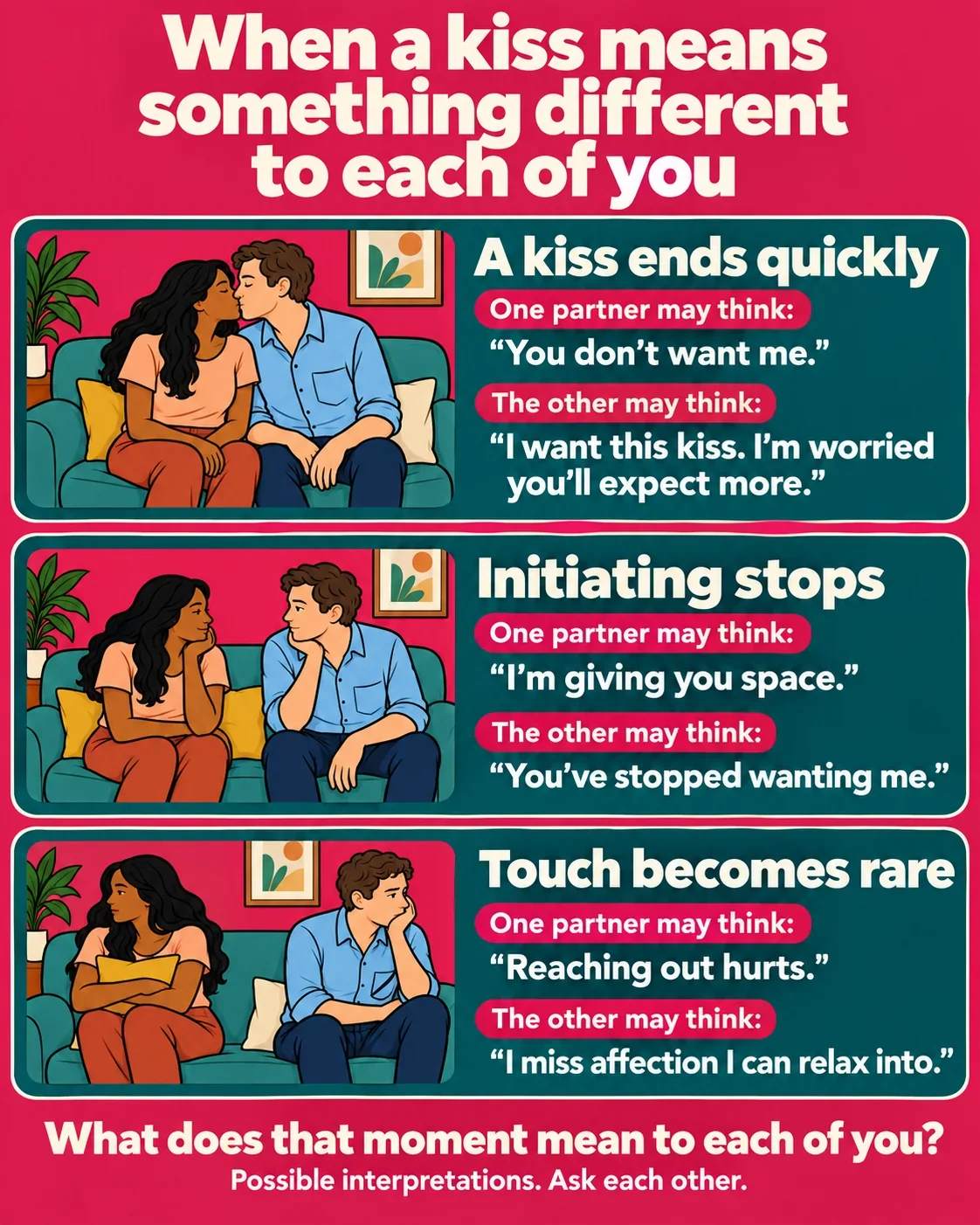
The same moment can mean different things
These are possible interpretations. Ask each other which, if any, fit.
A kiss ends quickly
One partner may think: “You don’t want me.”
The other may think: “I want this kiss. I’m worried you’ll expect more.”
Initiating stops
One partner may think: “I’m giving you space.”
The other may think: “You’ve stopped wanting me.”
Touch becomes rare
One partner may think: “Reaching out hurts.”
The other may think: “I miss affection I can relax into.”
What does that moment mean to each of you?
How do demanding jobs affect differences in desire?
Demanding jobs change when there is time and energy left for sex. Travel and exhaustion shrink the hours when both of you are awake and present, and a timing gap can look a lot like a desire gap.
Work and load is the second thing I look at. I ask for the actual week, including travel, early starts, late email and who carries the household’s running list. If your only overlap is Thursday at 10:30 p.m., you are comparing one person’s desire at the end of a 14-hour day with the other’s at the end of a different 14-hour day.
At home, the partner holding more of the household’s moving parts often has less left at night, and saying yes can start to feel like one more item on the list. My post on the mental load in high-achieving couples goes into that imbalance from both sides.
Some of this responds to plain scheduling. My post on work-life balance as a couple covers practices for protecting time together through demanding years. A better calendar can give the conversation a fairer setting, even when the difference in desire stays where it was.
Is it a medical question, a couples question, or both?
A physician should assess physical signs. The pattern between you is couples work, and many couples need both at once.
ACOG’s patient guide on sexual health, written for women, lists hormonal changes such as pregnancy and menopause among common causes of sexual problems, along with some illnesses and medications, relationship problems, and stress. In its treatment guidance, it notes that a person may be referred to a sex therapist even while receiving medical treatment, and that couples therapy may help. Whatever your gender, a physician is the right person to assess whether a medication or a health change is involved.
In my practice, these are the lines I use:
Pain during sex, a sudden change in desire, the months after a birth, or a question about medication or hormones: I suggest seeing a physician, such as an OB-GYN or a urologist, alongside our work.
A specific sexual function difficulty: I refer to a certified sex therapist, with medical assessment when physical symptoms or medication may be involved.
A history of sexual trauma: I recommend specialized individual care.
When none of these is present, a difference in desire is the kind of concern I work with regularly in couples therapy.

What does couples therapy for mismatched sex drives look like?
Couples therapy for mismatched sex drives starts with an assessment of both partners and the pattern between you. From there, the work is about how you talk about desire and how you handle a no, with a referral when something medical or specific needs its own care. No therapist can promise that your levels of desire will match.
With me, it begins with a free 20-minute consultation. Couples who go ahead have a joint intake session, and then I meet with each partner individually.
Individual meetings are especially useful with desire, because it is hard to say in front of your partner that you dread bedtime, or that you have started counting the days. In the individual meeting, each of you can tell me what desire and pressure feel like from your side. What you say there is confidential. If something you share works against the goals we set as a couple, I will ask you to bring it into a joint session.
The work depends on consent. A no is a complete answer, and the goal is a conversation you can both have without one of you feeling pressured or the other feeling dismissed. There is no target number to hit.
Neither of you owes the other sex. You can choose a time to discuss the difference when both of you are willing and feel safe. If refusal brings threats or fear, an individual assessment of safety comes first.
A hypothetical example: the couple who stopped asking
Noor and Elliot are a hypothetical composite of common patterns, and none of the details belong to a real client. Treat the example as an illustration.
The problem. They are in their early 40s, together 11 years, with one child. Noor is a partner at a law firm and travels three weeks a month. Elliot runs product at a health-tech company. About eight months ago, Elliot stopped initiating. Noor felt relief at first, then a distance that neither of them could name over dinner. They book a consultation after an anniversary trip where they both stayed on their phones until midnight.
The pursuit. After the joint intake, each has an individual meeting. Noor says that most of the nos came at 11 p.m. on travel days, and that the dread was about the conversation that followed a no. Noor also mentions occasional pain, so the suggestion is to see a physician alongside couples work. Elliot says that at some point the asking had turned into counting days, and that stopping felt like the only way to stop counting.
Joint sessions would bring both accounts into the room. They could agree to talk about desire at breakfast on a weekend instead of in bed, and look at which nights Noor’s travel leaves free.
The aim. A couple like Noor and Elliot might still want sex at different rates. Their goals could include responding to a no with less distance and understanding what each person is protecting. Whether they reach those goals depends on their circumstances. A physician would assess the pain.
If this sounds like your house, I work with a limited number of California-based couples, virtually across the state and in person in San Francisco. You can book a free 20-minute consultation to talk about whether we’re a fit or who else should be involved, or read more about how I work in couples therapy.
What should you ask before choosing help for a desire gap?
Describe what you have noticed, then ask how the provider would work with it and when they would refer. Use the five areas below to prepare for a first call. They can’t diagnose anything.
The pattern after a no
You might notice: one of you has stopped initiating, or a no turns into a cold evening.
What to describe: who usually initiates and what each of you does afterward.
What to ask: “How do you work with both partners when one wants sex more often?”
Work and load
You might notice: your only overlap is late at night, or one of you carries most of the household.
What to describe: a typical week, including travel and who handles what at home.
What to ask: “Do you look at schedules and workload as part of this?”
Physical changes
You might notice: pain, a sudden change in desire, the months after a birth, or a new medication.
What to describe: when it started. ACOG suggests simple opening lines for a physician, such as “I do not enjoy sex like I used to.”
What to ask: “Would you want me to see a physician first, or at the same time?”
A specific sexual function difficulty
You might notice: a problem with arousal or orgasm that shows up regardless of timing or mood.
What to describe: what happens, and since when.
What to ask: “Do you treat this yourself, or do you work with a certified sex therapist?”
A history of sexual trauma
You might notice: touch brings up fear or memories.
What to describe: only what you are comfortable sharing on a first call.
What to ask: “How would individual trauma care fit with couples work?”
My guide on how to choose a couples therapist covers the first call more broadly. If the desire gap sits inside a wider distance, roommate marriage may describe your situation more closely.
Frequently asked questions
Is it normal for couples to have different sex drives?
Yes. Desire discrepancy is common in long-term relationships, and the European Society for Sexual Medicine suggests treating variation in desire as normal. Neither partner’s level is the correct one.
How do you manage a relationship with very different sex drives?
Start by talking about it outside the bedroom, at a time when nothing needs to be decided. Look at your schedules and workload, and check whether anything physical has changed. In one study, strategies that involved both partners were associated with higher satisfaction than strategies people used alone.
Can mismatched libidos end a relationship?
They can contribute. Distance and resentment around the difference can add to the strain. Couples who can talk about a no without it ending the evening have more options. Nobody can predict the outcome for a particular couple.
Should we see a sex therapist or a couples therapist?
It depends on what is driving the gap. A pattern around invitations and refusals is regular couples-therapy work. A specific sexual function difficulty may need a certified sex therapist and medical assessment. Physical signs such as pain or a sudden change call for a physician. Some couples need more than one of these.
Can I talk about sex privately during couples therapy?
In my practice, yes. After the joint intake, each partner has an individual meeting, and what you say there is confidential. If something works against the goals you set as a couple, I will ask you to raise it in a joint session.
Starting with the minute after a no
Two people who want sex at different rates can still have a close relationship. The place to start is what happens in the minute after one of you says no, because that minute shapes how the next invitation and the next refusal go.
If you are a California-based couple and this sounded familiar, I keep a limited number of consultation slots open each month. Book a free 20-minute consultation. We can use the time to work out whether couples therapy fits, or whether a physician or sex therapist should come first.
This article is educational. Assessment and treatment depend on your circumstances.
About the Author

Giulia P. Davis, LMFT #157653 & Founder Mycelia Therapy
(she/any pronouns)
Giulia P. Davis, LMFT is an Italian-born, San Francisco-based Licensed Marriage and Family Therapist and founder of Mycelia Therapy.
Before transitioning to clinical practice, she spent 15 years as a management consultant for Fortune 500 clients, building distributed teams across three continents and eventually founding her own consultancy. She brings that same systems-thinking lens to the work she does with couples, understanding relationships not just as emotional bonds, but as dynamic structures that can be diagnosed, interrupted, and rebuilt.
Giulia specializes in working with high-achieving couples, executives, entrepreneurs, and ENM/polyamorous relationships facing disconnection, recurring conflict, and the particular exhaustion of a life that looks successful from the outside and feels depleted from within. Her intensive and retreat offerings are designed specifically for couples who need accelerated change.
Her work combines attachment theory, Emotionally Focused Therapy (EFT), Gottman frameworks, Relational Life Therapy (RLT), and Internal Family Systems (IFS). Formats offered: weekly therapy, intensives, and psychedelic-assisted therapy.