Money Dysmorphia: Why High Earners Still Feel Financially Unsafe

Your bonus cleared on Friday. This morning you opened your brokerage app twice before getting out of bed. Last night you left a long weekend in Big Sur sitting in your cart, well within budget, to think about it some more.
If you earn well and still feel one bad quarter away from trouble, you may have come across the term money dysmorphia. It describes a gap between how you’re doing financially and how safe you feel. If you’re good at judging risk at work, that gap can be hard to explain to yourself.
I spent 15 years in management consulting for Fortune 500 clients before I became a therapist in San Francisco. My view is that feeling financially safe is a judgment you make against a reference point. Success tends to raise that reference point faster than it raises your cushion, because each step up brings wealthier peers into view and a bigger portfolio gives a bad month more to take.
Key takeaways
Money dysmorphia is a popular term for feeling less financially secure than your situation suggests. It is not a clinical diagnosis.
Success can move your reference point, through wealthier peers and more to lose.
Income alone can’t show whether a fear is out of proportion, so check your exposure first.
A financial professional can assess your exposure. Therapy helps when the fear stays after the numbers check out.
What is money dysmorphia?
Money dysmorphia, sometimes called financial dysmorphia, is an informal term for a lasting gap between your financial situation and how secure you feel about it. It usually describes people who are doing well by any outside measure and still feel broke or behind. The term does not appear in the DSM-5-TR, the manual clinicians use to diagnose mental health conditions.
The name borrows from body dysmorphic disorder, a recognized and often serious condition, so hold the comparison loosely. The money version spread through social media and consumer surveys and has no agreed clinical definition.
Financial anxiety is the better-studied relative. Shapiro and Burchell, writing in the Journal of Neuroscience, Psychology, and Economics in 2012, measured it as distinct from depression and general anxiety. On one attention task, people high in financial anxiety tended to look away from financial information.
Money dysmorphia symptoms people commonly describe include:
Checking balances or portfolios many times a day, with relief that fades within minutes
Guilt or distress over purchases that fit comfortably in your budget
Feeling behind whenever you compare yourself with peers
Treating each raise or vesting date as the new minimum
Avoiding statements or money conversations, sometimes in the same week as the constant checking
What causes money dysmorphia in high earners?
High earners can feel unsafe because the sense of safety often comes from comparison, and success changes who you compare yourself with. A promotion or a new neighborhood puts you among people with more, so your best year of earnings can leave you nearer the bottom of the room.
Pay comparisons register even when your own pay stays the same. In a randomized study published in the American Economic Review, economists gave some University of California employees easy access to colleagues’ salaries. Workers who learned they were paid below the median for their unit and occupation reported lower job satisfaction and became more likely to look for a new job.
Workers above the median reported no gain in satisfaction. The study measured job satisfaction, so applying it to financial anxiety is my interpretation.
A raise can move you into a room where you’re nearer the bottom than you were last year.
Your reference point also has a history, as economists Ulrike Malmendier and Stefan Nagel showed using U.S. household survey data from 1964 to 2004. People who had lived through low stock market returns were less willing to take financial risk, and early experiences still showed an influence several decades later.
Their research concerned market returns. My clinical view is that family history works in a similar way.
If money ran out when you were young, or a parent’s business failed, your sense of danger may still be set to that year, whatever your accounts say now.
What happens when your net worth becomes a measure of you?
When your self-worth depends on financial success, money news starts to feel like news about you. Psychologists at the University at Buffalo found that people who staked their self-worth on financial success made more financial comparisons and reported more stress and anxiety, along with less autonomy.
Under a financial threat, the same people saw their financial problems more negatively and were more likely to disengage from them. That mix may explain why someone can check their accounts constantly and still put off the meeting with their planner.
Ambition is a capacity, and wanting to earn well is a reasonable part of it. Trouble starts when the number also has to answer whether you’re good enough. Job titles can carry the same weight, which I wrote about in how AI overwhelm can become a professional identity crisis.
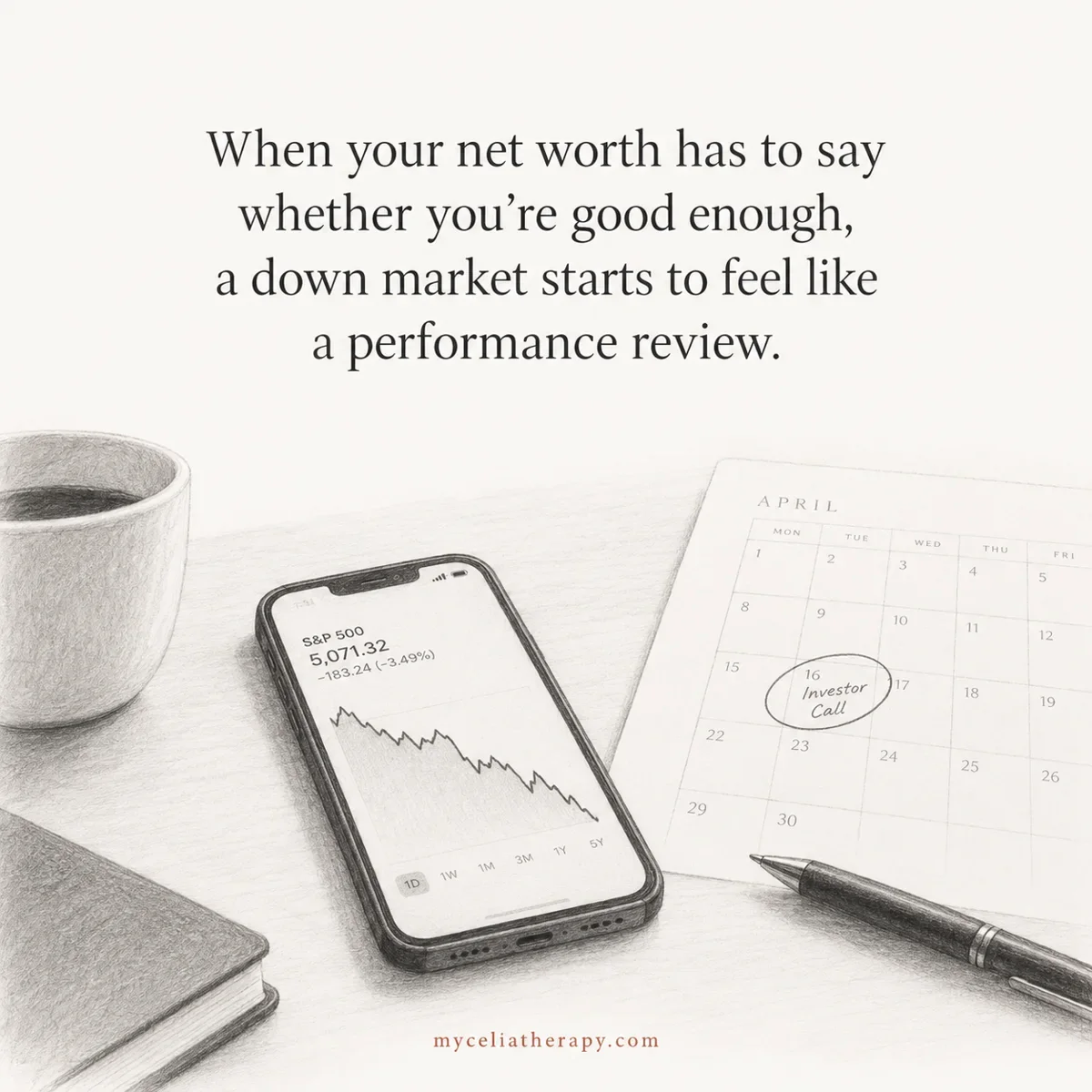
When your net worth has to say whether you’re good enough, a down market starts to feel like a performance review.
How do you know if your financial fear is out of proportion?
You can only judge whether a fear is out of proportion against an accurate picture of your exposure. Income alone won’t give you that picture, because two people on the same salary can face very different risks depending on how their wealth is held and what they owe each month.
Consulting assessments of a business treat revenue as the starting number. The harder questions are about cash and concentration, meaning how long the company could operate if revenue stopped and how much of it depends on one customer. The same two questions apply to a household.
Your income tells you how much comes in. Your exposure tells you how long you could last if it stopped.
A hypothetical example: two directors, one salary
Maya and Chris are hypothetical, and none of their details belong to a real person.
Both are directors at Bay Area tech companies earning $450,000 a year. Maya holds most of her net worth in her employer’s stock, much of it unvested, and carries a large mortgage. Chris holds a diversified portfolio and keeps a year of expenses in cash.
If both lie awake about money, Maya’s worry is pointing at something real, and she has a planning problem to address first. If Chris worries just as much, the more useful question is why his numbers don’t reassure him.
What should you ask a financial planner?
A Certified Financial Planner or CPA can test your exposure with four questions, using your actual numbers. This article isn’t financial advice, so treat these as questions to bring to that meeting:
How many months of fixed costs could you cover if your income stopped?
How much of your net worth sits in a single company’s stock, counting unvested grants?
Which assets could you turn into cash within a month without a large loss?
Which fixed obligations, such as a mortgage or tuition, would be hardest to cut?
The Consumer Financial Protection Bureau defines financial well-being to include both the capacity to absorb a financial shock and the freedom to make choices that let you enjoy life. If you have a fear of spending money even when your position is sound, the second half is missing.
If the answers show real exposure, the fear is giving you useful information and the next step is a plan. If they come back solid and the worry is unchanged, the remaining work is psychological.
What does emotional wealth add to financial security?
Emotional wealth is the framework I use for the resources that keep you secure alongside your money. Two matter most for financial fear.
One is the people you trust with the truth about your finances. The other is your own agency, meaning your ability to earn and to make decisions under pressure.
These resources don’t appear on a brokerage statement, and they still change what a bad year would mean.
The people who would take your call after a layoff are part of your financial security, even though no account statement lists them.
The Buffalo findings point the same way, since tying self-worth to money went with less autonomy, the sense that your choices are your own. Research supports parts of this framework, and the framework as a whole is my clinical perspective.
One person who knows your real numbers and your real worry gives you somewhere to test whether the fear fits. If money worry has turned into recurring arguments at home, my article on why couples fight about money covers that side.
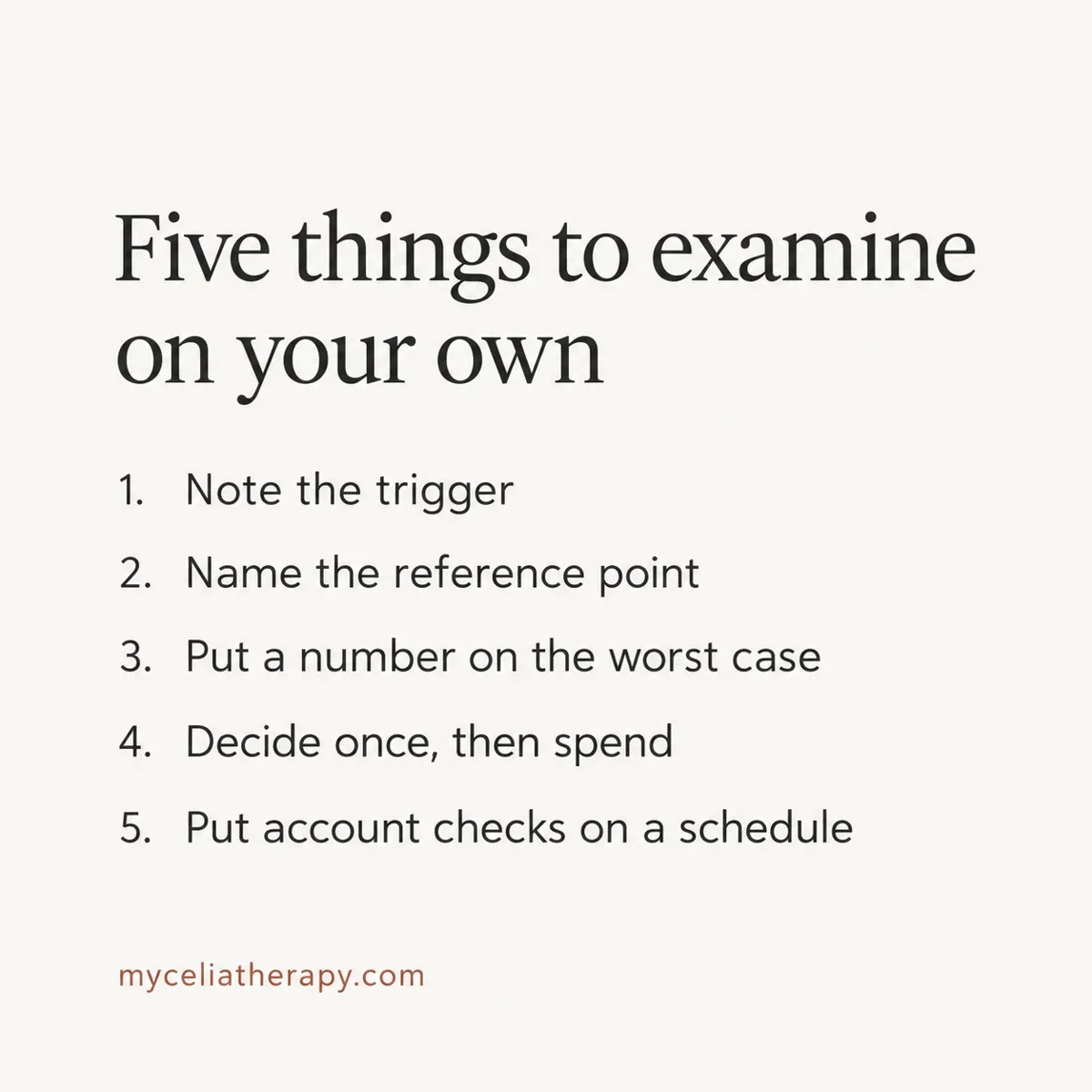
Five things to examine on your own
Start by treating each spike of financial fear as something to study, and keep notes for a few weeks.
Note the trigger. Write down what happened just before the spike, such as a colleague’s house purchase or a red day in the market.
Name the reference point. Ask who or what you were measuring against. It is often a peer, or the worst financial year you’ve lived through.
Put a number on the worst case. Write down the realistic worst case and how likely it is, then compare it with your planner’s answers.
Decide once, then spend. Agree on a spending range for travel or dining with your planner, and let purchases inside it go through without a second review.
Put account checks on a schedule. Pick a set time, such as Friday afternoon, and notice what the urge does in between.
When should you talk to a therapist about money anxiety?
Consider therapy when the fear stays after your financial picture checks out, or when it costs you sleep or shapes decisions you would otherwise make differently. Some signs it may be time:
A planner has told you your position is sound, and the worry hasn’t moved.
You lose sleep over money most weeks.
You put off spending you’ve already agreed is affordable, including health care or time off.
Checking accounts takes up time in the workday or wakes you at night.
Money has become a recurring argument with your partner.
A financial professional answers what your money can do. A therapist works on why that answer doesn’t settle you, including family history and how closely your worth is tied to the number. Financial therapy, an emerging field with its own professional association, combines the two.
My consulting years make equity grants and liquidity events familiar vocabulary, and I leave the financial advice to your planner. With your written consent, I can coordinate with them.
You can read more about my work with executives and founders in California. If money worry sits inside a wider pattern of exhaustion, start with my article on executive burnout that looks like high performance.
Frequently asked questions
Is money dysmorphia a real diagnosis?
No. Money dysmorphia is a popular term, and it does not appear in the DSM-5-TR. Researchers have studied and measured financial anxiety, the experience it points to, and a therapist can help with that anxiety without needing the label.
Why do I feel broke when I have money?
Often because you’re comparing yourself with people who have more, or because your sense of danger was set during an earlier period of real scarcity. Sometimes the feeling is accurate, since a high income can sit alongside concentrated equity or very little cash. A financial professional can tell you which applies.
How do I stop feeling guilty about spending money?
Start by deciding with your planner what you can afford in a category, then treat purchases inside that range as already approved. Researchers including Carnegie Mellon’s George Loewenstein have described a sharp “pain of paying” that leads some people to spend less than they themselves would like. If guilt persists on spending you’ve agreed is sound, it is worth exploring in therapy.
Can a therapist help with financial anxiety without giving financial advice?
Yes. Therapy addresses the fear and the history behind it, while a qualified financial professional handles the plan. Some people work with both, and with your consent the two can coordinate.
Your numbers and your sense of safety
A strong income and a persistent sense of danger can both be true. Sometimes the danger is real and needs a plan. Sometimes your sense of safety has drifted away from your situation, and a therapist can help you work on that part.
If you’re based in California and this sounds familiar, you can book a free 20-minute consultation. I keep a limited number of consultation times open each month. On the call, we can sort out which part of your concern belongs with a therapist and which belongs with your planner.
This information is educational and is not a substitute for professional mental health or financial advice. If you are in crisis or thinking about suicide, call or text 988 to reach the 988 Suicide and Crisis Lifeline.
About the Author

Giulia P. Davis, LMFT #157653 & Founder Mycelia Therapy
(she/any pronouns)
Giulia P. Davis, LMFT is an Italian-born, San Francisco-based Licensed Marriage and Family Therapist and founder of Mycelia Therapy.
Before transitioning to clinical practice, she spent 15 years as a management consultant for Fortune 500 clients, building distributed teams across three continents and eventually founding her own consultancy. She brings that same systems-thinking lens to the work she does with couples, understanding relationships not just as emotional bonds, but as dynamic structures that can be diagnosed, interrupted, and rebuilt.
Giulia specializes in working with high-achieving couples, executives, entrepreneurs, and ENM/polyamorous relationships facing disconnection, recurring conflict, and the particular exhaustion of a life that looks successful from the outside and feels depleted from within. Her intensive and retreat offerings are designed specifically for couples who need accelerated change.
Her work combines attachment theory, Emotionally Focused Therapy (EFT), Gottman frameworks, Relational Life Therapy (RLT), and Internal Family Systems (IFS). Formats offered: weekly therapy, intensives, and psychedelic-assisted therapy.